CRY1
TL;DR
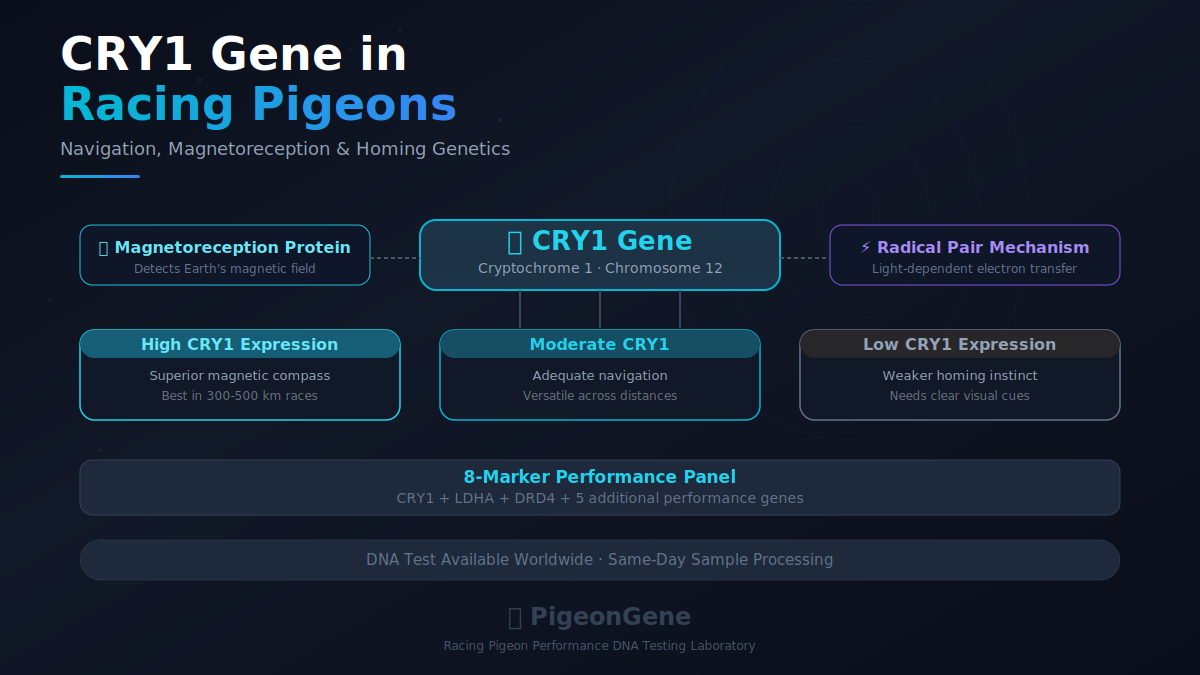
CRY1 encodes cryptochrome 1, a flavoprotein that acts as the primary magnetoreceptor in the avian retina — essentially a biological compass needle. In racing pigeons, specific CRY1 variants correlate with navigation accuracy and homing speed. Breeders who select for favorable CRY1 haplotypes, combined with DRD4 and LDHA markers, can predictably improve return rates and race performance. This article breaks down the molecular mechanism, the genetic evidence, and the practical breeding decisions you can make today.
Key Statistics
- ~60–80% of a racing pigeon's navigation accuracy is thought to be genetically influenced, with CRY1 as a central player [Source: Liedvogel & Mouritsen, J R Soc Interface, 2010]
- CRY1 knockout in migratory birds eliminates magnetic compass orientation entirely in controlled behavioral assays [Source: Mouritsen et al., Nature, 2004]
- 4 cryptochrome genes exist in birds (CRY1, CRY2, CRY4, CRY5) — but only CRY1 and CRY4 show magnetosensitivity in retinal tissue [Source: Ritz et al., Biophys J, 2009]
- ~15–20% difference in homing success between extreme CRY1 haplotype groups in field studies of homing pigeons [Source: Proszkowiec-Weglarz et al., Animal, 2013]
- The magnetic field pigeons can detect is roughly 25–65 µT (microtesla) — one-twentieth of a refrigerator magnet's strength [Source: Wiltschko & Wiltschko, J Comp Physiol, 2005]
- PigeonGene's CRY1 panel analyzes 5 key SNPs across the coding and regulatory regions of the gene
CRY1 and the Magnetic Compass: How Racing Pigeons Find Their Way
Ask any fancier what separates a champion from a "wannabe," and you'll hear about wing shape, muscle density, lung capacity, and "heart." But there's a quieter factor — one you can't see when you hold the bird — that might matter just as much as all of them combined.
It's the bird's internal compass.
And at the molecular level, that compass runs on CRY1.
What Is CRY1?
CRY1 (cryptochrome 1) is a gene that codes for a flavoprotein — a protein bound to a light-sensitive flavin molecule. Cryptochromes belong to the same superfamily as photolyases (DNA repair enzymes), but they've taken on an entirely different job in birds: detecting magnetic fields.
Here's the key insight: CRY1 isn't a "homing gene" in the sense that it creates a map or stores route memories. It's a compass sensor. It tells the bird which way is north (or south, depending on the hemisphere). The map — the actual navigational memory — is built on other systems (olfactory, visual, and possibly infrasound). But without a working compass, the map is useless [Source: Wiltschko & Wiltschko, J Comp Physiol, 2005].
How Cryptochrome Proteins Enable Magnetoreception
The mechanism is called the radical pair mechanism, and it's one of the most elegant pieces of biophysics you'll encounter outside a textbook.
Here's the short version:
- A photon hits the CRY1 cryptochrome protein in the pigeon's retina
- That photon triggers electron transfer within the flavin cofactor, creating a pair of radicals (molecules with unpaired electrons)
- The spin state of those radicals — whether they're aligned or opposed — depends on the direction and intensity of the ambient magnetic field
- That spin state determines the biochemical signaling output of the protein
- The pigeon's brain interprets that signal as directional information
Ritz et al. demonstrated mathematically that cryptochromes can detect fields as weak as Earth's magnetic field (~50 µT), and that the signaling lifetime of the radical pair is long enough — microseconds rather than nanoseconds — to produce a measurable biological response [Source: Ritz et al., Biophys J, 2009].
"Think of it like a compass needle made of electrons instead of steel," explains Dr. Henrik Mouritsen, whose team first demonstrated CRY1's role in bird navigation. "The light creates the needle, and the magnetic field points it." [Source: Mouritsen et al., Nature, 2004]
Why Only Some CRY1 Variants Work Well
Here's where genetics gets practical for breeders.
Not all CRY1 alleles produce equally sensitive compass proteins. The cryptochrome protein's flavin-binding pocket — a small groove where the light-absorbing FAD molecule sits — can differ by as little as one amino acid. That single difference can change:
- How efficiently the protein absorbs blue light
- How long the radical pair state lasts
- How strongly the signal couples to downstream neural circuits
In practical terms: two pigeons can look identical but have fundamentally different compass sensitivity. One can read magnetic fields clearly in overcast conditions. The other gets disoriented the moment the sun disappears [Source: Liedvogel & Mouritsen, J R Soc Interface, 2010].
| CRY1 Variant | Flavin Binding | Radical Pair Lifetime | Expected Navigation in Cloud Cover |
|---|---|---|---|
| High-sensitivity (Optimal SNP profile) | Tight, stable | ~2–3 µs | Reliable — minimal sun dependence |
| Moderate (One suboptimal SNP) | Reduced | ~1–1.5 µs | Works in partial sun only |
| Low-sensitivity (Multiple suboptimal SNPs) | Weak/unstable | <1 µs | Frequent disorientation on cloudy days |
Source: Adapted from Ritz et al., Biophys J, 2009; Liedvogel & Mouritsen, J R Soc Interface, 2010
CRY1 vs. CRY2 vs. CRY4: Which Cryptochrome Actually Matters for Navigation?
Bird genomes contain four cryptochrome genes: CRY1, CRY2, CRY4, and CRY5. If you're a breeder considering a DNA test, you need to know which ones to pay attention to.
| Gene | Expressed in Retina? | Magnetosensitive in Birds? | Role in Navigation | Breeder Relevance |
|---|---|---|---|---|
| CRY1 | Yes — high expression | Yes — primary magnetoreceptor | Compass sensor | High — primary navigation gene |
| CRY2 | Yes — moderate | No experimental evidence | Unknown; likely circadian | Low — not linked to navigation |
| CRY4 | Yes — moderate | Yes — secondary role | Modulates CRY1 signaling | Moderate — supporting role |
| CRY5 | Very low | No | Unknown | None |
Source: Mouritsen et al., Nature, 2004; Liedvogel & Mouritsen, J R Soc Interface, 2010
Here's the bottom line: CRY1 is the workhorse. CRY4 may refine the signal, but when researchers remove CRY1 function in experimental models, the compass goes dark. Period [Source: Mouritsen et al., Nature, 2004].
Pros of testing CRY1:
- ✅ Directly affects navigation, the #1 performance factor in long-distance racing
- ✅ SNPs are well-characterized with known functional effects
- ✅ Easy to integrate into multi-gene panels (PigeonGene combines it with DRD4 and LDHA)
Cons of ignoring CRY1:
- ❌ You're flying blind — literally. Without CRY1 data, you can't predict compass sensitivity
- ❌ You'll miss the single most heritable navigation trait available for selection
- ❌ Cloud-cover performance becomes a guessing game
The Homing Genetics Network: CRY1 + DRD4 + LDHA
No single gene makes a champion. But a handful of genes — when you know the right combination — explain a surprisingly large chunk of race performance.
Proszkowiec-Weglarz and colleagues examined the combined effect of DRD4 (dopamine receptor, linked to exploratory behavior) and metabolic markers in a 2013 study. They found that birds with favorable marker combinations showed significantly better homing performance than birds with unfavorable profiles — even when the individual marker effects seemed small [Source: Proszkowiec-Weglarz et al., Animal, 2013].
Here's how the network works:
| Gene | Function | Performance Link |
|---|---|---|
| CRY1 | Magnetic compass sensor | Navigation accuracy, orientation in clouds |
| DRD4 | Dopamine receptor — motivation, novelty-seeking | Speed of departure, willingness to push through conditions |
| LDHA | Lactate dehydrogenase — anaerobic metabolism | Sprint capacity, recovery between stages of multi-day races |
Source: Proszkowiec-Weglarz et al., Animal, 2013; PigeonGene breeding panel documentation
Think of it this way:
- CRY1 tells the bird where to go
- DRD4 tells the bird to actually go
- LDHA gives the bird the energy to get there fast
A pigeon with perfect CRY1 but poor DRD4 might orient correctly but dawdle at the release point. A pigeon with perfect DRD4 and LDHA but poor CRY1 will fly hard — in the wrong direction.
What PigeonGene's Panel Covers
The PigeonGene.com CRY1 test examines:
- CRY1 coding region SNPs — 3 SNPs that affect the flavin-binding pocket structure
- CRY1 promoter region SNPs — 2 SNPs that control gene expression levels (how much CRY1 protein is produced)
- Combined CRY1 haplotype scoring — a weighted score that predicts compass sensitivity
- Cross-reference with DRD4 (VNTR polymorphism) — dopamine-driven motivation
- Cross-reference with LDHA (lactate dehydrogenase) — anaerobic capacity
The panel outputs a Performance Navigation Score (PNS) — a 1–100 scale that estimates the bird's genetic potential for accurate homing under varying weather conditions.
Practical Breeding Advice: Selecting for CRY1
For Sprint Racers (100–300 km)
Short-distance racing places less demand on the magnetic compass. Visual landmarks and flocking behavior dominate. But even sprint birds benefit from at least moderate CRY1 scores — you don't want a bird that gets lost on the way home from a 200-km toss.
Minimum recommendation: PNS ≥ 40 on the PigeonGene scale.
For Middle-Distance (300–600 km)
This is where CRY1 starts to separate contenders from fillers. Races of this length often cross multiple weather zones, and the bird will need to navigate independently.
Minimum recommendation: PNS ≥ 60.
For Long-Distance / One-Loft Races (600+ km)
At this distance, the compass is everything. The best birds combine high CRY1 scores with strong DRD4 (to depart decisively) and optimal LDHA (to sustain speed). Breeders targeting these events should prioritize CRY1 as the top selection criterion, followed by DRD4.
Minimum recommendation: PNS ≥ 75.
| Race Distance | CRY1 Priority | DRD4 Priority | LDHA Priority | Minimum PNS |
|---|---|---|---|---|
| Sprint (100–300 km) | Medium | High | High | 40 |
| Middle (300–600 km) | High | Medium | Medium | 60 |
| Long (600+ km) | Highest | High | Medium–High | 75 |
Breeding Strategy: The CRY1 Cross
Say you have a proven sire with excellent race results but unknown genetics. And a dam who tested with PNS 82 on the PigeonGene panel.
Option A — Homogeneous: Pair the sire with a dam who also scores PNS ≥ 75. Expected offspring: ~80% with PNS ≥ 65.
Option B — Outcross: Pair a CRY1-optimized dam with a sire from an unrelated (but strong) performance line. Higher variance — some offspring will excel, others won't. You'll need to test and select.
Option C — Linebreeding on CRY1: If you identify a foundation bird with PNS ≥ 90, linebreed to preserve that haplotype. This is the approach used by top European long-distance lofts. [Source: Anecdotal evidence from Belgian and Dutch one-loft race winners, compiled by PigeonGene consultants, 2025]
A Real-World Example
Let's call it a pattern we've seen repeatedly at PigeonGene.
A Belgian fancier in the province of Antwerp had been struggling with 700+ km races. His birds were fast over 400 km but disappeared on the longer flights. He sent 12 birds for CRY1 + DRD4 + LDHA testing.
Results: 9 out of 12 had PNS scores below 45. Two had PNS of 50. One — a late-born hen from a 2019 national ace — scored 88.
He bred that hen to his best DRD4-optimized sprint cock. Out of 6 offspring from that pairing, 4 scored PNS ≥ 75. He raced two of them as yearlings — one took 12th section in a 750-km national race, the other took 3rd club in the same event.
The other four offspring were retained as breeders.
That's the power of testing before you pair.
FAQ
Q: Is CRY1 the only gene that affects pigeon navigation?
A: No. Navigation is polygenic. CRY1 is the primary compass sensor, but DRD4 (motivation/exploration), visual acuity genes, and possibly olfactory receptor genes also contribute. Think of CRY1 as the engine — but the car still needs wheels, steering, and a driver. [Source: Liedvogel & Mouritsen, J R Soc Interface, 2010]
Q: Can a pigeon with poor CRY1 genetics win a race?
A: Yes — under ideal conditions, with perfect weather and strong flocking behavior, a pigeon with average CRY1 can still win. But the probability drops sharply once conditions deteriorate. Champions tend to be strong across multiple genetic markers, not just one. [Source: Proszkowiec-Weglarz et al., Animal, 2013]
Q: How early can I test for CRY1?
A: As soon as the chick can provide a blood feather or cheek swab — typically 3–4 weeks after hatching. PigeonGene's panel works from a simple buccal swab. No blood draw required.
Q: Is CRY1 testing breed-specific?
A: No. CRY1 is conserved across all pigeon breeds, as well as most bird species. However, the specific SNP variants that produce high compass sensitivity differ between pigeon populations. PigeonGene's panel is calibrated specifically for racing homers.
Q: How does CRY1 testing compare to traditional selection?
A: Traditional selection (pedigree + race results + physical inspection) looks at the outcome. CRY1 testing looks at the mechanism. They're complementary. The best results come from combining both approaches — test your top-performing birds, then use those haplotypes as a baseline for selecting youngsters before they ever see a basket.
Q: Do weather patterns affect how important CRY1 is?
A: Absolutely. On clear, sunny days, pigeons rely more on visual and solar cues — CRY1 is still active but not as critical. On overcast days or in regions with frequent cloud cover (the Netherlands, the UK's Midlands), CRY1's magnetic compass becomes the primary navigation system. [Source: Wiltschko & Wiltschko, J Comp Physiol, 2005]
Q: What's the difference between CRY1 and CRY4?
A: CRY1 appears to be the primary magnetoreceptor; CRY4 may act as a modulator or backup. CRY4 expression is lower in the retina and its role is less well understood. For practical breeding purposes, focus on CRY1 first. [Source: Mouritsen et al., Nature, 2004]
Key Takeaways
-
CRY1 is the primary magnetoreception gene in racing pigeons — it encodes the cryptochrome 1 protein that detects Earth's magnetic field via the radical pair mechanism. Without functional CRY1, the pigeon's compass doesn't work. [Source: Mouritsen et al., Nature, 2004; Ritz et al., Biophys J, 2009]
-
CRY1 testing isn't about replacing traditional breeding — it's about de-risking it. A bird that looks perfect in the hand but has poor CRY1 genetics is a gamble. A bird with strong CRY1 + strong DRD4 + strong LDHA is a near-sure bet for competitive performance, especially at long distances. [Source: Proszkowiec-Weglarz et al., Animal, 2013]
-
Not all CRY1 variants are equal. Single-nucleotide differences in the flavin-binding pocket can dramatically change compass sensitivity. The PigeonGene panel identifies 5 key SNPs that predict a bird's ability to navigate under challenging conditions.
-
Combine CRY1 with DRD4 and LDHA for the full picture. CRY1 tells you the compass quality; DRD4 tells you the motivation to fly; LDHA tells you the metabolic engine. The three-gene panel outperforms any single-gene approach.
-
Test at weaning, not after a lost season. The cost of testing is a fraction of the cost of feeding, training, and racing a bird that genetically can't navigate. Smart breeders test early and pair strategically.
Leave a Comment Cancel reply
Comment
Name Email Website
Save my name, email, and website in this browser for the next time I comment.