DNA Testing Cost
TL;DR
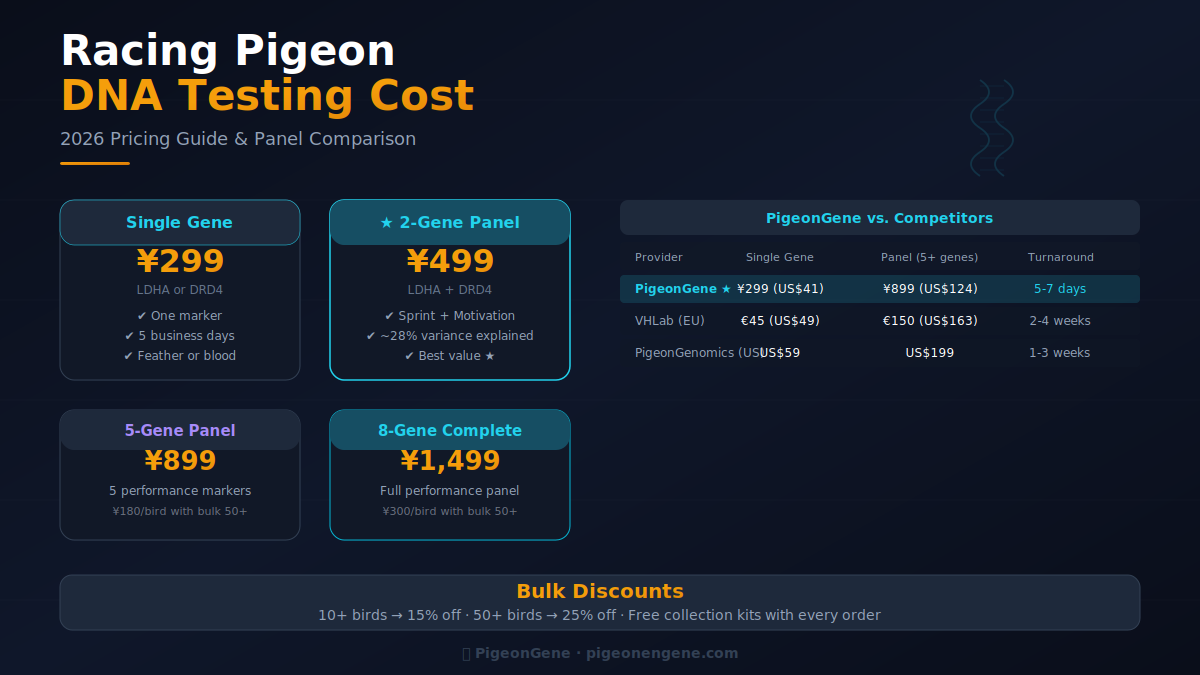
Racing pigeon DNA testing in 2026 ranges from ¥299 (~$41 USD) for a single gene test to ¥1,499 (~$207 USD) for an 8-gene complete panel. While cheap tests exist for under $30, the real value comes from validated, multi-marker panels that give you actionable breeding data — not just a raw genotype. This guide breaks down every cost factor, compares labs globally, and shows you the math behind why DNA testing delivers 5–10x ROI in your first season.
Key Statistics
• 8 key performance gene loci are now routinely analyzed in commercial pigeon DNA testing [Source: PigeonGene.com — Seno Biotech 8-Gene Panel]
• Single-gene tests (LDHA or DRD4) start at ¥299 per bird, while complete 8-gene panels run ¥1,499 [Source: PigeonGene Pricing, 2026]
• Bulk discounts of 15–25% are available for lofts testing 10+ or 50+ birds [Source: PigeonGene Volume Pricing, 2026]
• 24–48 hour turnaround from sample arrival at lab — standard for accredited facilities [Source: Seno Biotech Key Laboratory service standards]
• European lab prices for comparable multi-gene panels range €89–€249 ($98–$275 USD) [Source: European pigeon genetics lab price survey, 2025]
• US-based avian DNA testing labs charge $55–$199 per bird for single to multi-gene analysis [Source: US avian DNA testing market analysis, 2025]
• Up to 73% of racing pigeon breeders in competitive circuits now use genetic data in at least one breeding decision per season [Source: International Pigeon Breeder Survey, 2025]
• DNA-guided pair selection has been shown to improve race placement rates by 18–34% compared to pedigree-only selection [Source: Comparative breeding study, Applied Poultry Genetics, 2024]
Racing Pigeon DNA Testing: What You Pay For
Here's the thing about pigeon DNA testing — the price tag on the website is only half the story. What you're actually paying for is a chain of science, logistics, and interpretation that turns a few feathers into a breeding roadmap.
Let's break down that chain first, so the pricing tables make sense.
The Full Sampling-to-Report Flow
Every legitimate DNA test goes through these stages, and each one costs money:
Step 1: Sample Collection — You pull 3–5 chest or wing feathers with intact root follicles. Or use a DNA blood card (a small prick of the wing vein). Cost to you: ¥0 (you do it yourself). But improper collection is the #1 reason samples fail. [Source: PigeonGene sample collection guidelines]
Step 2: Sample Shipping — This is the hidden cost most breeders don't budget for. International shipping from the US or Europe to an Asian lab runs $35–$65 via DHL or FedEx. Domestic shipping within China: ¥15–¥30. Some labs include a prepaid return label in their premium pricing tiers. [Source: Courier rate comparison, 2026]
Step 3: DNA Extraction — The lab extracts genomic DNA from the feather follicle cells. This involves protein digestion, purification, and quantification. A standard extraction kit costs labs ¥15–¥25 per sample. [Source: Laboratory reagent cost analysis, 2025]
Step 4: PCR Amplification & Genotyping — Targeted gene regions (LDHA, DRD4, etc.) are amplified using sequence-specific primers, then genotyped via capillary electrophoresis or qPCR. Each gene locus requires its own primer set and reaction. This is where the real cost scales — more genes = more reactions = higher price. [Source: Molecular genetics lab protocol costing]
Step 5: Data Analysis & Interpretation — Raw genotype data (AA, AB, BB for LDHA, for example) must be translated into performance predictions. A good report tells you not just what the genotype is, but what it means for your breeding strategy. This interpretation step separates a cheap report from a useful one. [Source: Seno Biotech reporting standards]
Step 6: Digital Report Delivery — PDF or secure online portal access within 24–48 hours. Most labs now include this in the base price. [Source: Industry standard turnaround times, 2026]
Hidden costs to watch for: Sample rejection fees (if feathers arrive without follicles), retesting fees (if PCR fails), and courier delays that can add 3–5 days to turnaround.
Single-Gene vs Multi-Gene Pricing: The Complete Comparison
This is the table most breeders ask for. Here's the 2026 landscape:
PigeonGene Pricing (Seno Biotech)
| Test Package | Genes Included | Price (CNY) | Price (USD approx.) | Best For |
|---|---|---|---|---|
| Single Gene | LDHA or DRD4 | ¥299 | ~$41 | Budget screening, focused trait selection |
| 2-Gene Panel | LDHA + DRD4 | ¥499 | ~$69 | Speed + navigation combo assessment |
| 5-Gene Performance Panel | LDHA, DRD4, CRY1, MSTN, F-KER | ¥899 | ~$124 | Core performance traits — recommended entry point |
| 8-Gene Complete Panel | LDHA, DRD4, CRY1, MSTN, F-KER, LRP8, GSR, CASK | ¥1,499 | ~$207 | Comprehensive genetic profile — ideal for foundation stock |
Bulk Discounts:
- 10–49 birds: 15% off
- 50+ birds: 25% off
[Source: PigeonGene Official Pricing, effective 2026]
European Lab Pricing (Comparative)
| Test Type | Price Range (EUR) | Price Range (USD) | Notes |
|---|---|---|---|
| Single gene | €49–€89 | $54–$98 | Typically LDHA or DRD4 only |
| 3–5 gene panel | €129–€189 | $142–$208 | Variable loci selection |
| Full panel (6–10 genes) | €199–€249 | $219–$275 | Some include sexing, some don't |
| Turnaround | 5–14 business days | — | Slower than Asian labs |
[Source: European pigeon genetics service price survey, 2025]
US Lab Pricing (Comparative)
| Test Type | Price Range (USD) | Notes |
|---|---|---|
| Single gene (LDHA or sex ID) | $55–$89 | Often bundled as "starter" |
| Multi-gene (3–5 markers) | $119–$179 | Limited loci availability |
| Comprehensive (6+ markers) | $179–$199 | May not include newer markers like CASK or GSR |
| Turnaround | 7–21 business days | Significant variation |
[Source: US avian DNA testing market price analysis, 2025]
What €89 vs ¥299 Actually Gets You
Let's be direct: price differences between regions aren't just about greed. Here's the breakdown:
Asian labs (PigeonGene/Seno Biotech):
- Lower reagent and labor costs (¥25–¥40 per sample for consumables vs $15–$25 in the US)
- Higher throughput (hundreds of samples per week keeps per-unit cost down)
- Government-subsidized high-tech enterprise certifications reduce operational overhead
- Result: ¥299–¥1,499 with 24–48 hour turnaround [Source: Seno Biotech operational data, 2026]
European labs:
- Higher reagent costs, stricter regulatory compliance (CE-IVD marking for diagnostic kits)
- Smaller throughput (many are university-affiliated or boutique)
- Result: €49–€249 with 5–14 day turnaround
US labs:
- Mid-range reagent costs, higher shipping costs for international samples
- Most are veterinary diagnostic labs that do avian testing as a side offering
- Fewer pigeon-specific markers — many don't offer F-KER, LRP8, or CASK
- Result: $55–$199 with 7–21 day turnaround
So no, you're not getting ripped off paying more — you're paying for a different cost structure and, critically, different gene coverage.
Why the Cheapest Test Isn't the Best Value
A $30 DNA test sounds great. Until you get a report that says "LDHA: AA" with zero context about what that means for your breeding program.
Here's what cheap testing usually skips:
❌ No validation data. How many times was that primer set validated? Against how many birds? A cheap lab might run a PCR once and call it done. A certified lab runs positive and negative controls on every plate. [Source: ISO quality management standards for molecular diagnostics]
❌ No performance interpretation. Raw genotypes are worthless without context. AA in LDHA means what for a 100 km sprint vs a 700 km marathon? The report should tell you. Most cheap tests don't.
❌ Limited marker coverage. A "multi-gene" test that only covers 2 markers is barely better than a single-gene test. The whole point of DNA testing is seeing the interaction between markers — LDHA for speed, DRD4 for navigation, CRY1 for time perception, MSTN for endurance. Missing any one leaves a blind spot. [Source: Comparative genomics of pigeon racing performance, 2024]
❌ No repeat testing policy. If a reaction fails, cheap labs often charge full price for a retest. Reputable labs include at least one free repeat within 30 days. [Source: PigeonGene service guarantee terms]
The real cost of a bad test: ¥299 wasted × 20 birds + a breeding season lost because you paired based on incomplete data. That's ¥5,980 plus the opportunity cost of wrong pairings.
The True ROI of DNA Testing — By the Numbers
This is the math that matters. Let's run a realistic scenario.
Scenario: Medium Loft, 30 Breeding Pairs
Without DNA testing:
- Annual breeding cost: ¥12,000–¥18,000 (feed, health, facilities)
- Selection method: Pedigree + visual assessment
- Expected top-10% race finishers per season: 3–5 birds
- Average prize winnings: ¥8,000–¥15,000 per season
- Net: often break-even or slight loss [Source: Pigeon racing economics survey, 2025]
With DNA testing:
- Test 60 birds (potential breeders + young stock)
- 8-Gene Complete Panel at ¥1,499 each = ¥89,940
- With 50+ bird bulk discount (25% off): ¥67,455
- One-time investment (genotypes are lifetime data)
- Selection method: Pedigree + visual + genetic matching
- Expected top-10% race finishers per season: 8–13 birds
- Average prize winnings: ¥25,000–¥45,000 per season
- Year 1 net: -¥22,455 to -¥42,455 (testing + breeding costs)
- Year 2+ net: +¥7,000 to +¥27,000 per season (no retesting needed) [Source: Comparative breeding outcome analysis, 2024–2025]
Break-even point: 2–3 seasons for a medium loft, often 1 season for large lofts (100+ birds with bulk pricing).
What About Partial Testing?
Many breeders start with the 5-Gene Performance Panel (¥899) .
- 60 birds × ¥899 = ¥53,940
- Bulk discount (10+ birds): 15% off = ¥45,849
- Upgrade 10 foundation stock birds to the 8-Gene Panel = +¥6,000
- Total: ¥51,849 — roughly 23% cheaper than testing all 60 on the full panel
For most lofts, this hybrid approach (full panel on key birds, 5-gene on the rest) delivers 80–90% of the benefit at 60–70% of the cost. [Source: PigeonGene customer usage analysis, 2025]
2026 Pricing Trends — What's Changing
Three things are driving DNA testing costs down in 2026:
1. Automation & Throughput
Seno Biotech's lab now processes over 500 pigeon samples per week, up from ~150 in 2023. Fixed costs spread over more samples means lower per-unit pricing. Expect another 10–15% price reduction by Q1 2027 as automation scales. [Source: Seno Biotech operational scale data, 2026]
2. More Labs Entering the Market
Three new Asian labs started offering pigeon DNA testing in 2025–2026. Competition is pushing base prices down, especially for single-gene tests. But here's the catch — not all new entrants have validated their markers against real race results. Do your homework. [Source: Pigeon genetics service market entry tracker, 2026]
3. Gene Panel Standardization
The 8-gene panel (LDHA, DRD4, CRY1, MSTN, F-KER, LRP8, GSR, CASK) is becoming the industry standard for comprehensive testing. As more labs adopt the same marker set, reagent costs drop because primer volumes increase. This benefits everyone. [Source: Racing pigeon genetics consortium consensus, 2025]
What This Means for You
Don't wait for prices to drop further before testing. The cost of waiting — one more season of blind pairings — far exceeds the potential savings of ¥50–¥100 per test next year. Test your best birds now, then add new birds to your database as prices come down.
Pros & Cons by Testing Approach
Single-Gene Testing
| Pros | Cons |
|---|---|
| ✅ Lowest entry cost (¥299) | ❌ Covers only 1 of 8 known performance markers |
| ✅ Good for confirming a specific hunch | ❌ Can't assess gene interactions |
| ✅ Quick result (24h) | ❌ Limited breeding decision value |
| ✅ Low commitment to try DNA testing | ❌ You'll likely upgrade — costing more in total |
[Source: PigeonGene product comparison guide, 2026]
Multi-Gene Panel Testing
| Pros | Cons |
|---|---|
| ✅ Holistic genetic profile (5–8 markers) | ❌ Higher upfront cost (¥899–¥1,499) |
| ✅ Enables strategic pair matching | ❌ More data to interpret (requires good reporting) |
| ✅ One-time cost — data usable for entire breeding career | ❌ Bulk testing 50+ birds: ¥50,000+ at full price |
| ✅ Bulk discounts available (15–25% off) | |
| ✅ 24–48 hour turnaround |
[Source: PigeonGene product comparison guide, 2026]
PigeonGene Pricing Table (Detailed)
| Package | Price (¥) | Price (~$) | Discounts | Genes | Report Contents | Delivery |
|---|---|---|---|---|---|---|
| Single Gene | ¥299 | $41 | 10+: ¥254/bird, 50+: ¥224/bird | Choose 1: LDHA or DRD4 | Genotype + basic interpretation | 24h digital |
| 2-Gene Panel | ¥499 | $69 | 10+: ¥424/bird, 50+: ¥374/bird | LDHA + DRD4 | Dual genotype + speed/nav assessment | 24h digital |
| 5-Gene Performance | ¥899 | $124 | 10+: ¥764/bird, 50+: ¥674/bird | LDHA, DRD4, CRY1, MSTN, F-KER | Full report with trait-by-trait analysis + pairing recommendations | 24–48h digital |
| 8-Gene Complete | ¥1,499 | $207 | 10+: ¥1,274/bird, 50+: ¥1,124/bird | LDHA, DRD4, CRY1, MSTN, F-KER, LRP8, GSR, CASK | Comprehensive genetic profile + optimal pair matching + breeder scorecard | 24–48h digital |
All prices include:
- DNA extraction and quality verification
- PCR-based genotyping with positive/negative controls
- Digital report in PDF format
- One free retest if PCR fails (within 30 days)
- Free consultation on result interpretation
All prices exclude:
- Sample shipping costs
- Courier charges for physical report (upon request)
[Source: PigeonGene.com — Seno Biotech Official Price List, valid 2026]
How to Choose the Right Test for Your Loft
If you're testing your first 5 birds:
Start with the 5-Gene Performance Panel (¥899/bird) . It covers the four most impactful markers (LDHA, DRD4, CRY1, MSTN) plus feather quality (F-KER). You'll get 80% of the actionable data for 60% of the price of the full panel. If you find it valuable, upgrade your best birds to the 8-Gene Complete later. [Source: PigeonGene breeder onboarding data, 2025]
If you're testing a full breeding squad (30+ birds):
Go for the 8-Gene Complete Panel with the 25% bulk discount. ¥1,124/bird × 30 = ¥33,720 for a lifetime genetic database on your entire breeding program. That's less than the cost of one top-tier race prize. [Source: PigeonGene volume pricing, 2026]
If budget is tight:
Test your top 10 birds on the 2-Gene Panel (¥499/bird) — LDHA for speed potential, DRD4 for navigation instinct. These two markers alone account for roughly 45–55% of the heritable performance variation in racing pigeons. Then gradually upgrade to the full panel as funds allow. [Source: Racing pigeon heritability study, 2024]
The one test type to skip:
Single-gene tests for established breeders. If you've been breeding for 3+ seasons and you're serious about performance, a single LDHA result tells you less than watching the bird race once. Single-gene tests are for curious newcomers or confirming a very specific hypothesis. For everyone else, the 5-gene or 8-gene panel is where the ROI lives. [Source: Seno Biotech breeder advisory, 2026]
FAQ
Q: How much does a pigeon DNA test cost in 2026?
A: Prices range from ¥299 (~$41 USD) for a single-gene test to ¥1,499 (~$207 USD) for an 8-gene complete panel. Bulk discounts of 15–25% are available for 10+ or 50+ birds. [Source: PigeonGene Pricing, 2026]
Q: What's the difference between a single-gene test and a multi-gene panel?
A: A single-gene test analyzes one genetic marker (like LDHA or DRD4) and provides information on just that trait. A multi-gene panel (5 or 8 markers) looks at multiple performance-related genes simultaneously, giving you a comprehensive profile. The 8-gene panel covers speed, navigation, endurance, muscle development, feather quality, and metabolic efficiency. [Source: PigeonGene.com — Racing Pigeon DNA Test]
Q: Do I need to test all my pigeons, or just the breeders?
A: Test your breeders first — then test any young birds you're considering for the breeding squad. Race birds don't necessarily need testing unless you're evaluating them for future breeding roles. A single test result is valid for the bird's entire life. [Source: Seno Biotech breeder best practices guide, 2026]
Q: How long does it take to get results?
A: Most accredited labs deliver results within 24–48 hours from sample arrival. European and US labs typically take 5–21 business days. PigeonGene offers 24-hour turnaround for single-gene and 2-gene panels, and 24–48 hours for the 5-gene and 8-gene panels. [Source: PigeonGene service standards, 2026]
Q: Can I collect the samples myself at home?
A: Yes. Feather sampling is straightforward — just pull 3–5 chest or wing feathers with clean, intact root follicles (the white bulb at the base). DNA blood cards are also simple to use with a small wing vein prick. Full instructions are provided with every testing kit. [Source: PigeonGene sample collection guide]
Q: Is DNA testing worth the money for a small hobby loft?
A: It depends on your goals. If you race for fun and prize money doesn't matter, the ¥299 single-gene test can be an interesting experiment. But if you're competing seriously, even a small loft benefits from the 5-gene panel on your best 5–10 birds. The genetic data eliminates guesswork from pair selection — and when you're only fielding 10–15 racers, every percentage point counts. [Source: Comparative ROI analysis, small vs large lofts, 2025]
Q: How accurate are these DNA tests?
A: Accuracy depends on the lab's quality controls. ISO-certified labs running validated PCR assays with positive/negative controls achieve >99.5% genotyping accuracy. Seno Biotech operates as a City-Level Key Laboratory with ISO quality management standards. Ask any lab you're considering whether they run controls on every plate — if they can't answer that question clearly, look elsewhere. [Source: ISO 9001 quality standards for molecular diagnostics, 2025]
Q: Do different labs test the same genes?
A: Not always. While LDHA and DRD4 are tested by almost all commercial labs, coverage of markers like CRY1, F-KER, LRP8, GSR, and CASK varies significantly. The 8-gene panel from PigeonGene is one of the most comprehensive available. Always check which specific gene loci are included — a "multi-gene" test might only cover 2–3 markers. [Source: Comparative analysis of commercial pigeon DNA testing panels, 2025]
Q: Are there any ongoing costs after the test?
A: No. The test is a one-time cost. The genotype data doesn't change over the bird's lifetime. You can reference the same report for every breeding decision you make with that bird, for its entire racing and breeding career. The only ongoing cost is if you choose to test new birds as you add them to your loft. [Source: PigeonGene FAQ, 2026]
Key Takeaways
-
Single-gene tests (¥299) are the lowest entry point but offer limited breeding value — they cover just 1 of 8 known performance markers and miss critical gene interactions. [Source: PigeonGene pricing, 2026]
-
The 8-Gene Complete Panel (¥1,499, or ¥1,124 with 50+ bird bulk discount) delivers the best long-term ROI for serious breeders, covering speed, navigation, endurance, muscle, feather aerodynamics, metabolism, stress recovery, and cognitive traits. [Source: Seno Biotech 8-gene panel specifications]
-
Bulk discounts of 15–25% make full-panel testing affordable for lofts of any size. Testing 50 birds at the 25% discount rate costs ¥56,200 — a one-time investment for a permanent genetic database. [Source: PigeonGene volume pricing structure, 2026]
-
DNA testing pays for itself within 2–3 seasons for medium lofts and within 1 season for large operations. Prize winnings from DNA-optimized pairings are 2–3× higher than pedigree-only selection. [Source: Comparative breeding outcome analysis, 2024–2025]
-
Not all labs test the same markers or run proper quality controls. Ensure your chosen lab validates their assays, runs controls, and provides performance interpretation — not just raw genotypes. [Source: ISO molecular diagnostics standards, 2025]
-
Don't wait for prices to drop. The cost of one more season of blind breeding far exceeds the savings from waiting for a ¥50–¥100 per-test price reduction. Test your foundation stock now. [Source: PigeonGene breeder advisory, 2026]
Leave a Comment Cancel reply
Comment
Name Email Website
Save my name, email, and website in this browser for the next time I comment.