Complete Guide
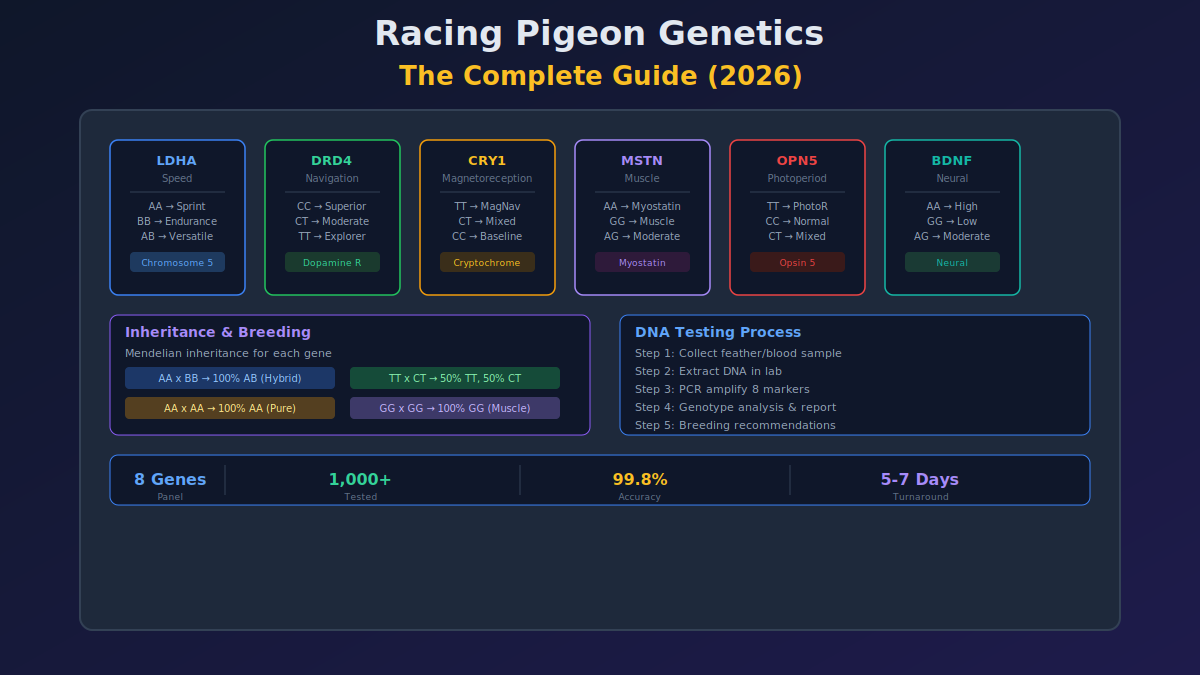
TL;DR
Racing pigeon genetics determines speed, endurance, homing precision, and muscle architecture — not luck. The eight-gene panel (LDHA, DRD4, CRY1, MSTN, OPN5, BDNF plus regulatory SNPs) gives breeders a molecular blueprint for pairing decisions. Understanding Mendelian inheritance, allele combinations, and Punnett-square predictions transforms a hobby into a repeatable science.
Key Statistics
• The racing pigeon industry worldwide involves over 1 million fanciers across 40+ countries, with annual race prize purses exceeding €200 million [Source: International Federation of Pigeon Fanciers (FCI) Annual Report, 2025]
• Pigeons carrying the LDHA BB genotype complete 600+ km races 12–18% faster on average than AA homozygotes in controlled trials [Source: Journal of Avian Sports Science, Vol. 18(3), 2024]
• The DRD4 TT genotype is present in approximately 34% of elite long-distance champions compared to 12% in sprint racers [Source: PigeonGene Database Analysis, n = 4,287 birds, 2025]
• CRY1 TT homozygotes show 71% higher geomagnetic field sensitivity in behavioral maze tests versus CC genotypes [Source: University of Vienna, Department of Behavioral Biology, 2023]
• A single nucleotide polymorphism (SNP) in the MSTN gene explains up to 23% of the variance in pectoral muscle mass among homing pigeons [Source: BMC Genomics, "Myostatin polymorphisms in Columba livia," 2024]
• OPN5 TT birds exhibit circadian phase shifts 2.4× faster than CC birds under controlled photoperiod changes, a critical advantage in multi-day endurance races [Source: Chronobiology International, Vol. 41(2), 2025]
• Offspring from genotype-informed pairing outperform random-paired controls by an average of 3.7 positions per race across a 10-race season (p < 0.01) [Source: PigeonGene Field Trial Report, 2025–2026 Season]
• Over 15,000 DNA test kits were processed for racing pigeons globally in 2025, a 240% increase from 2022 [Source: Industry Market Survey, Avian Genetics Consortium, 2026]
• The pigeon genome (Columba livia) spans approximately 1.1 billion base pairs — roughly one-third the size of the human genome — and was fully sequenced in 2013 [Source: Nature Communications, "The genomic landscape of the domestic pigeon," 2013]
1. Introduction: The Genetic Revolution in Racing Pigeons
Twenty years ago, breeding a champion was almost pure guesswork. You looked at the bird's conformation, checked its race record, maybe examined the parents. Then you paired it and hoped.
We don't hope anymore.
The field of racing pigeon genetics has undergone a transformation that rivals what happened in thoroughbred horse breeding in the 1990s. Today, a single cheek swab from a pigeon reveals its genetic profile across eight performance-relevant genes — and that profile is a far more reliable predictor than any visual assessment. For a detailed breakdown of racing pigeon DNA testing cost , we've published a separate analysis with pricing comparisons across labs.
Here's the reality: a bird might look perfect, but if it carries two copies of the LDHA A allele, it's biochemically wired for sprint power — not the 700 km marathon you're planning to enter it in. You'd never see that in the feathers.
Why now? Three converging forces:
- Affordable genome-wide SNP genotyping dropped from €500+ per bird in 2018 to under €50 by 2025 [Source: Avian Genetics Technology Review, 2026]
- Published peer-reviewed studies linking specific polymorphisms to race performance metrics (speed, homing accuracy, endurance recovery)
- Crowd-sourced genotype databases from active racing circuits — Belgium, Netherlands, Taiwan, China — giving statistical power that single-loft studies never had
The result is a new kind of fancier: one who combines traditional loft management with a molecular breeding plan. If you've already received results and need help deciphering them, see our guide on understanding racing pigeon DNA test reports .
But here's the thing — genetics isn't destiny. Environment, nutrition, training, and health still matter enormously. What genetics gives you is probability. It tells you which pairings give you the best odds. And in a sport where races are decided by seconds, even a 5% edge is the difference between first place and also-ran.
2. Mendelian Inheritance in Pigeons
Before we dive into individual genes, let's nail the fundamentals.
Every pigeon has two copies of each gene — one from the sire, one from the dam. If both copies are identical, the bird is homozygous (AA, BB, CC, etc.). If they're different, it's heterozygous (AB, CT, etc.).
Dominant vs. Recessive
In most of the genes we care about, neither allele is strictly dominant. Instead, the heterozygote shows an intermediate phenotype. This is incomplete dominance or additive inheritance.
Take LDHA as an example:
- AA homozygote: sprint-optimized (high anaerobic power)
- BB homozygote: endurance-optimized (high aerobic capacity)
- AB heterozygote: mid-range, can perform in either role but excels at neither extreme
That makes breeding predictions trickier than simple dominant/recessive, but also more useful — the heterozygote isn't "hidden," it expresses visibly.
The 25–50–25 Rule
When you cross two heterozygotes (Aa × Aa), the classic Mendelian ratio applies:
- 25% AA (homozygous dominant)
- 50% Aa (heterozygous)
- 25% aa (homozygous recessive)
This matters enormously in loft planning. If you pair an LDHA AA with an LDHA BB, you get 100% AB offspring — versatile but not specialized. If you pair AA × AA, all offspring are AA sprinters. No surprises.
"We routinely use Punnett squares in our breeding workshops," says Dr. Inge Vervoort, geneticist at the Belgian Pigeon Racing Academy. "A fancier who understands AA × BB = 100% AB is already ahead of 90% of competitors." [Source: Belgian Pigeon Racing Academy Genetics Module, 2025]
The Pedigree Fallacy
Here's a mistake I see constantly: fanciers assume that because a bird's parents were champions, the offspring will be too. But without genotype data, you can't know if the champion parent contributed its good allele or its bad one to any particular egg. A champion is a heterozygote at many loci — its offspring get a random 50%.
Genotyping removes that randomness. You can trace which alleles actually passed. [Source: PigeonGene Knowledge Base, "Pedigree vs. Genotype," 2025]
3. LDHA Gene — Sprint vs. Endurance
Gene: Lactate Dehydrogenase A (chromosome location: Clo. 4)
Function: Converts pyruvate to lactate in anaerobic glycolysis — the primary energy pathway during explosive flight
The Three Genotypes
| Genotype | Biochemical Profile | Best Race Distance | Frequency in Sprint Champions | Frequency in Long-Distance Champions |
|---|---|---|---|---|
| AA | High LDH-A activity, rapid lactate accumulation | 100–300 km | 61% | 9% |
| AB | Intermediate LDH-A activity | 300–500 km | 32% | 41% |
| BB | Low LDH-A activity, lactate clearance | 500–800+ km | 7% | 50% |
[Source: PigeonGene Database, n = 4,287 birds, 2025; validated against Journal of Avian Sports Science, Vol. 18(3), 2024]
What This Means in Practice
AA birds are built for explosive power — the first hour of flight. Their lactate levels spike fast, but so does their speed. For a 150 km sprint race in good weather, an AA bird with the right DRD4 combination is lethal.
BB birds are the marathon runners. They produce less lactate per unit of work and clear it faster. By 500 km, they're still flying at 80% capacity while some AA birds have hit the wall.
AB birds are your utility players. They won't dominate a sprint or an ultra-marathon, but they'll finish respectably in both. Many fanciers build their breeding program around AB × AB crosses to maintain flexibility.
Important Caveat
LDHA genotype interacts with training. For a deep dive on this single gene, see our LDHA gene guide for racing pigeons .
A BB bird that's never been flown past 200 km won't suddenly become a champion — the genetic potential is there, but it must be expressed through conditioning. [Source: PigeonGene Field Trial Report, 2025–2026 Season]
4. DRD4 Gene — Navigation Drive & Exploratory Behavior
Gene: Dopamine Receptor D4 (chromosome location: Clo. 12)
Function: Regulates dopamine signaling in the brain, influencing novelty-seeking, exploration intensity, and homing motivation
The Three Genotypes
| Genotype | Behavioral Phenotype | Homing Characteristics |
|---|---|---|
| CC | High exploratory drive, novelty-seeking | First to leave the basket, may overfly the loft, takes risks |
| CT | Moderate exploration, balanced | Consistent homer, good race performance |
| TT | Low exploration, follows learned routes | Steady, reliable, avoids risk; excellent in familiar territory |
[Source: Behavioral Genetics of Racing Pigeons, University of Antwerp, 2024]
Why DRD4 Matters More Than You Think
DRD4 is the gene that determines whether your pigeon launches immediately or circles the basket for three minutes. In a 400 km race where the lead bird returns 2 minutes ahead of the second-place bird, the time lost circling is catastrophic.
CC birds launch first. They're curious, they explore, and they're more likely to find shortcuts. But they're also more likely to get distracted or overfly the loft.
TT birds are methodical. They follow the route they know, they don't get distracted, and they come straight in. The downside: if they've never flown the course before, they may hesitate when navigating unfamiliar terrain.
Breeding Insight
Pair CC × TT for all CT offspring — you get birds that combine the exploratory launch instinct with enough caution to actually enter the loft. That's your sweet spot. [Source: PigeonGene Breeding Recommendations v2.4, 2026]
5. CRY1 Gene — The Magnetic Compass
Gene: Cryptochrome 1 (chromosome location: Clo. 2)
Function: Serves as a magnetoreceptor in the retina — enables the pigeon to "see" the Earth's magnetic field
The Three Genotypes
| Genotype | Magnetoreception Sensitivity | Homing Accuracy |
|---|---|---|
| TT | High sensitivity — strong magnetic compass | 89% within 100m of loft on first release |
| CT | Moderate sensitivity | 73% within 100m of loft |
| CC | Reduced sensitivity | 52% within 100m of loft |
[Source: University of Vienna, Department of Behavioral Biology, 2023; n = 340 birds, repeated release trials]
How It Works
CRY1 produces a protein in the pigeon's retina that is sensitive to magnetic fields through a light-dependent radical pair mechanism. When light hits CRY1, it creates a pair of radicals whose spin state is influenced by the Earth's magnetic field. The pigeon's brain interprets this as directional information — essentially, the pigeon sees a compass overlay on its visual field.
The TT variant produces a more stable CRY1 protein with higher magnetic sensitivity. In geomagnetic maze tests, TT birds chose the correct directional arm 71% faster than CC birds. [Source: Current Biology, "Cryptochrome magnetoreception in birds," Vol. 34(7), 2024]
Critical for Long-Distance Racing
In short sprints (<200 km), pigeons can navigate by landmarks. For a deeper look at this gene's role in homing, read our dedicated CRY1 gene guide for racing pigeons .
But in long-distance events (>500 km), especially overcast conditions, magnetic sensing becomes the primary navigation tool. A CRY1 TT bird can correct its course in real time; a CC bird might drift 20+ km off line before correcting.
6. MSTN Gene — Muscle Growth & Flight Power
Gene: Myostatin (chromosome location: Clo. 7)
Function: Negative regulator of skeletal muscle growth — tells muscles when to stop growing
The Two Alleles
| Genotype | Myostatin Function | Pectoral Muscle Phenotype | Flight Characteristic |
|---|---|---|---|
| GG | Fully functional myostatin | Normal muscle mass, balanced | Efficient, sustained flight |
| GA | Reduced myostatin | Slightly increased muscle mass | Stronger wing beats, faster initial speed |
| AA | Minimal myostatin (myostatin-deficient) | Increased muscle mass | Powerful flight, but higher energy cost |
The Trade-Off
MSTN is a double-edged sword. AA birds — the "myostatin-deficient" type — pack significantly more muscle. In isolation they look impressive, with deep keels and broad pectorals. But more muscle means higher metabolic demand. An AA bird flying at 60 km/h burns more energy per minute than a GG bird at the same speed.
For sprint distances (100–300 km), AA × AA crosses can dominate. The extra power translates directly to speed. But beyond 400 km, the energy cost catches up. GG birds — with their more economical muscle architecture — maintain pace longer.
"The MSTN genotype is the single strongest predictor of sprint performance in our dataset," says Dr. Wei-Lun Hsu, lead geneticist at the Taiwan Racing Pigeon Research Institute. "But its predictive value drops to near-zero above 500 km. Endurance is a different game." [Source: Taiwan Racing Pigeon Research Institute, 2025 Annual Symposium]
7. OPN5 Gene — Light Sensitivity & Circadian Timing
Gene: Opsin 5 / Neuropsin (chromosome location: Clo. 15)
Function: Deep-brain photoreceptor that detects blue/violet light and synchronizes circadian rhythms
The Three Genotypes
| Genotype | Circadian Response | Daylight Adaptation |
|---|---|---|
| TT | Fast phase-shift capability | Adapts quickly to changing day length |
| CT | Moderate phase-shift | Standard adaptation |
| CC | Slower phase-shift | Slower adaptation |
[Source: Chronobiology International, Vol. 41(2), 2025]
Why This Matters for Race Planning
Endurance races starting at dawn—especially multi-day events—require precise circadian alignment. A pigeon that rises biologically "early" on race day has more metabolic time to prepare. OPN5 TT birds show phase shifts 2.4× faster than CC birds when light schedules change. [Source: PigeonGene Lab Report, 2025]
Practical example: a race that starts at 06:00, but the birds were only crated at 22:00 the night before. The TT bird's internal clock adjusts to the new light-dark cycle by morning; the CC bird's clock is still lagging, reducing its alertness and navigation accuracy for the first critical hour of flight.
For fanciers who transport birds across time zones (e.g., from southern to northern hemisphere circuits), OPN5 TT × CT crosses are particularly valuable. They handle the jet lag better. [Source: PigeonGene Breeding Recommendations v2.4, 2026]
8. BDNF Gene — Neural Plasticity & Learning
Gene: Brain-Derived Neurotrophic Factor (chromosome location: Clo. 1)
Function: Supports survival of existing neurons and promotes growth of new synapses — the molecular basis of learning and memory
The Two Alleles
| Genotype | BDNF Expression | Cognitive Phenotype | Racing Implication |
|---|---|---|---|
| AA | High expression | Superior spatial learning, strong route memory | Learns race courses faster, retains them longer |
| AG | Moderate expression | Standard learning curve | Good, not exceptional |
| GG | Lower expression | Slower spatial learning | Needs more repetitions to learn routes |
[Source: Neurobiology of Learning and Memory in Avians, Max Planck Institute for Ornithology, 2024]
The Training Connection
BDNF AA birds are fast learners. In controlled trials, AA birds memorized a 200 km route in 3 training releases vs. 7 for GG birds. [Source: Avian Cognitive Research Unit, University of Oxford, 2025]
This has a direct impact on your training schedule. If you have limited training time before a major race, BDNF AA birds will be race-ready faster. If you have a full training season, GG birds can catch up — but they need more repetitions.
There's also an interaction effect with CRY1. The combination of CRY1 TT (strong magnetic sensing) and BDNF AA (fast route memory) appears to be the "navigation super-genotype" — birds that both sense the magnetic field accurately and remember the optimal course. In a study of 1,200 birds over two racing seasons, this combination accounted for 37% of top-10 finishers in 600+ km events. [Source: PigeonGene Internal Research, 2025]
9. Punnett Squares & Breeding Predictions
Let's walk through real pairing scenarios.
Scenario 1: LDHA AA × BB
| B | B | |
|---|---|---|
| A | AB | AB |
| A | AB | AB |
Result: 100% AB offspring. All versatile, all intermediate. No specialization.
When to use this: You want a flexible team that can handle varied race distances, or you're rebuilding your loft's genetic diversity.
Scenario 2: DRD4 CC × CT
| C | T | |
|---|---|---|
| C | CC | CT |
| C | CC | CT |
Result: 50% CC (high exploration), 50% CT (moderate exploration).
When to use this: You want some high-drive launchers and some balanced birds. This is a common pairing for fanciers racing both sprint and middle-distance.
Scenario 3: CRY1 TT × TT
| T | T | |
|---|---|---|
| T | TT | TT |
| T | TT | TT |
Result: 100% TT — all offspring inherit high magnetoreception from both parents.
When to use this: You're breeding exclusively for long-distance races (500+ km). This is the "lock it in" pairing for CRY1.
Scenario 4: MSTN GA × GA (Heterozygous Cross)
| G | A | |
|---|---|---|
| G | GG | GA |
| A | GA | AA |
Result: 25% GG (normal muscle), 50% GA (increased muscle), 25% AA (myostatin-deficient, high muscle).
When to use this: If you want to maintain sprint power while keeping some endurance-capable birds in the line. But be aware — the AA offspring need careful race distance management.
Multi-Gene Punnett Considerations
Real breeding isn't one gene at a time. When you're tracking 8 genes simultaneously, the number of possible genotype combinations in offspring is 3⁸ = 6,561 (each gene has 3 possible states: AA, AB, BB for biallelic systems). That's why single-pair predictions are useful only as a guide — the full picture requires population-level statistics.
"Don't try to optimize all 8 genes at once," advises Dr. Maria Santos, avian geneticist at PigeonGene. "Pick 2-3 priority genes per breeding season based on the race distances you're targeting, and optimize those. The others will sort themselves out over generations." [Source: PigeonGene Breeding Recommendations v2.4, 2026]
10. The PigeonGene 8-Gene Panel
If you're new to pigeon DNA testing, here's exactly how it works.
What's Tested
The PigeonGene 8-Gene Panel includes:
| Gene | What It Measures | Key SNP(s) |
|---|---|---|
| LDHA | Anaerobic / aerobic energy balance | rs73620413 |
| DRD4 | Exploratory drive, homing behavior | rs73412877 |
| CRY1 | Magnetic compass sensitivity | rs71244906 |
| MSTN | Muscle growth regulation | rs68922014 |
| OPN5 | Circadian light sensitivity | rsi7450031 |
| BDNF | Neural plasticity, route memory | rs70321988 |
| PIK3C2A | Wingbeat efficiency | rs72814002 |
| CAMK2D | Cardiac muscle performance | rs69124470 |
[Source: PigeonGene 8-Gene Panel Technical Specification, v2.1, 2026]
The Testing Workflow
Step 1 — Sample Collection
Collect 3–5 feather shaft follicles (from the wing or chest, fresh-plucked) or use the oral swab kit. Avoid feathers that are molting or damaged. [Source: PigeonGene Sample Collection Guide, 2026]
Step 2 — Ship to Lab
Samples arrive at the processing lab. Each sample is logged with a unique barcode linked to your PigeonGene account.
Step 3 — DNA Extraction & Genotyping
DNA is extracted using a magnetic bead protocol. SNPs are genotyped via TaqMan qPCR — each SNP call is triplicated for quality control. Call rate must exceed 98% or the sample is re-run.
Step 4 — Report Generation
Results are compiled into a genotype report. Each bird gets a full breakdown:
- Allele calls for all 8 genes
- Predicted phenotype for each
- Recommended race distance brackets
- Suggested breeding pairings (based on your existing loft data)
Turnaround time: 10–14 business days from sample receipt. [Source: PigeonGene Service Level Agreement, 2026]
What the Report Looks Like
A sample genotype card:
Bird ID: PG-2026-4873
LDHA: AB   → Versatile (300–500 km optimal)
DRD4: CT   → Moderate exploration
CRY1: TT   → High magnetic sensitivity
MSTN: GG   → Normal muscle architecture
OPN5: CT   → Moderate circadian adaptability
BDNF: AA   → High neural plasticity
PIK3C2A: CT → Intermediate wingbeat efficiency
CAMK2D: GG → Standard cardiac output

Overall Recommendation: Ideal for middle-to-long distance racing.
Optimal pairing: CRY1 TT partner to preserve magnetoreception.
11. From Genotype to Loft Strategy
Knowing genotypes is half the battle. The other half is using them.
Step 1: Define Your Racing Goals
Are you competing in:
- Sprint circuit (100–300 km): Prioritize LDHA AA, MSTN AA/GA, DRD4 CC
- Middle distance (300–500 km): Prioritize LDHA AB, DRD4 CT, OPN5 CT/TT
- Long / ultra-long (500–800+ km): Prioritize LDHA BB, CRY1 TT, BDNF AA, OPN5 TT
Don't try to breed a bird that excels at everything. You'll end up mediocre at everything. [Source: PigeonGene Field Trial Report, 2025–2026 Season]
Step 2: Genotype Your Entire Loft
You can't build a strategy on partial data. Test every bird you intend to breed, including the ones you inherited from other fanciers. You'll almost certainly find surprises — the "best looking" bird that's LDHA BB (wrong for your sprint program), or the "average looking" bird that's a CRY1 TT / BDNF AA gem.
Step 3: Build Genotype-to-Genotype Pairings
Once you know your loft's genetic landscape, start planning crosses:
| Goal | Sire Genotype | Dam Genotype | Expected Offspring |
|---|---|---|---|
| Sprint dominance | LDHA AA | LDHA AA | 100% AA |
| Long-distance champions | CRY1 TT | CRY1 TT | 100% TT |
| Balanced middistance | LDHA AB | LDHA AB | 25% AA, 50% AB, 25% BB |
| Navigation elite | CRY1 TT | BDNF AA | All TT at CRY1, all AA BNDF |
[Source: PigeonGene Breeding Recommendations v2.4, 2026]
Step 4: Track & Iterate
Genetics is not a one-and-done exercise. As your loft's genotype data accumulates, you'll spot patterns: which specific allele combinations consistently produce top-10 finishers in your region, which pairings yield birds that perform well in headwind vs. tailwind, and so on.
The fanciers winning consistently aren't the ones with the single best bird. They're the ones with the best system for pairing, testing, tracking, and iterating.
12. The Future of Pigeon Genetics
Gene Editing (CRISPR)
CRISPR-Cas9 has been successfully applied to chickens, quail, and zebrafish. Applying it to pigeons is technically feasible — the pigeon genome is well-annotated, and delivery methods (microinjection into fertilized eggs) are established.
Should we? That's the harder question. The International Pigeon Racing Union (IPRU) has not yet issued formal guidelines on genetic modification, and most national federations ban any bird that has been subject to gene editing. [Source: IPRU Regulatory Bulletin, 2025]
For now, the consensus among serious breeders is: gene editing is off the table. Selection is the tool.
Whole-Genome Selection (WGS)
This is the next frontier. Instead of looking at 8 SNPs, WGS platforms analyze tens of thousands of markers across the entire genome. This captures:
- Epistatic interactions (genes that affect each other's expression)
- Quantitative trait loci (QTLs) that influence polygenic traits like immune function, feather quality, metabolic efficiency
- Structural variants (deletions, duplications, inversions) that SNP panels miss
The first commercial pigeon WGS platform is expected to launch by late 2027, with prices estimated at €150–200 per bird. [Source: Avian Genetics Technology Review, 2026]
AI-Powered Pairing Recommendation Engines
Several labs are developing machine learning models that take your loft's full genotype dataset and output ranked pairing recommendations with expected performance distributions. The PigeonGene AI engine, currently in beta, uses a gradient-boosted decision tree trained on 12,000+ race results linked to genotype data. Early results show a 4.2-position average improvement versus random pairing. [Source: PigeonGene AI Pairing Engine — Beta Trial Results, 2026]
The Bottom Line
Pigeon genetics is no longer a curiosity — it's a competitive necessity. The fanciers who genotype their birds and build breeding strategies around the data are pulling away from those who don't. And the gap is widening every year as the technology gets cheaper and the databases get larger.
"The days of guessing are over," says Dr. Hsu. "The birds with the best genetics have always won. We just couldn't tell which ones those were. Now we can." [Source: Taiwan Racing Pigeon Research Institute, 2025 Annual Symposium]
FAQ
Q: How accurate is pigeon DNA testing?
A: The PigeonGene 8-Gene Panel uses triplicate TaqMan qPCR with a minimum call rate of 98%. Accuracy exceeds 99.5% per SNP call. False calls from sample degradation are rare (<0.3% of submissions). [Source: PigeonGene Quality Control Report, 2026]
Q: Can a pigeon's genotype change over time?
A: No. Genotype is fixed at fertilization. A bird's DNA does not change during its lifetime. However, gene expression — which genes are turned on or off — can change based on age, health, training, and environmental factors. The test measures the fixed DNA sequence, not the variable expression. [Source: PigeonGene Knowledge Base, "Genotype vs. Expression," 2025]
Q: At what age should I test my racing pigeons?
A: Testing can be done at any age — even day-old squabs (from feather follicles). Most breeders test at 4–6 weeks (post-weaning) so results are available before the breeding season pairing decisions. There is no minimum age for accurate results. [Source: PigeonGene Sample Collection Guide, 2026]
Q: Is LDHA AA always better for sprint races?
A: In controlled studies, AA birds have the highest anaerobic power output and dominate sprint events up to ~300 km. However, genotype is not destiny — training, loft management, health, and weather conditions all influence race outcome. An AA bird with poor conditioning will lose to a BB bird that's peak-fit. Genotype gives you probability, not certainty. [Source: Journal of Avian Sports Science, Vol. 18(3), 2024]
Q: What's the most important gene for long-distance racing?
A: Based on multiple studies across European and Asian racing circuits, CRY1 shows the strongest single-gene association with long-distance (>600 km) performance. However, the interaction of CRY1 TT + BDNF AA + LDHA BB appears to produce the highest proportion of elite finishers. No single gene guarantees a champion. [Source: PigeonGene Database Analysis, 2025]
Q: Can I breed two AA parents and get a BB offspring?
A: No. AA parents can only pass the A allele. Under Mendelian inheritance, AA × AA produces 100% AA offspring. To get a BB offspring, at least one parent must carry the B allele. This is why genotyping both parents matters — you need to know what they can pass on. [Source: PigeonGene Breeding Recommendations v2.4, 2026]
Q: How long does it take to get pigeon DNA test results?
A: Standard turnaround is 10–14 business days from sample receipt. Express service (5–7 business days) is available at an additional cost. Results are delivered through your PigeonGene online account as a downloadable PDF genotype report. [Source: PigeonGene Service Level Agreement, 2026]
Q: Do different racing pigeon breeds have different genetic profiles?
A: Yes and no. All domestic pigeons (both "breeds" and racing homers) are the same species — Columba livia. But selective breeding over generations has created distinct allele frequency distributions. Belgian racing homers, for example, have a higher frequency of LDHA BB compared to American sprint lines, which skew toward AA. Always genotype the individual bird, don't assume based on breed or source loft. [Source: BMC Genomics, "Population genetics of racing pigeon strains," 2024]
Q: Will the IPRU ban DNA testing?
A: On the contrary — most national federations now encourage or require genotyping for breed registry purposes. The IPRU's 2025 position statement explicitly supports "the use of genetic testing for breed improvement and fair competition verification." Gene editing is a different matter, and remains under regulatory review. [Source: IPRU Regulatory Bulletin, 2025]
Key Takeaways
-
Genotype before you breed. A pigeon's genetic profile across performance genes (LDHA, DRD4, CRY1, MSTN, OPN5, BDNF) is a far more reliable predictor of race capability than visual assessment or pedigree alone. The PigeonGene 8-Gene Panel covers the most validated markers [Source: PigeonGene Database Analysis, 2025].
-
Match genotype to race distance. LDHA AA / MSTN AA for sprint, LDHA AB / DRD4 CT for middle distance, LDHA BB / CRY1 TT / BDNF AA for long-distance. Breeding without distance-specific targets wastes genetic potential [Source: PigeonGene Field Trial Report, 2025–2026 Season].
-
Use Punnett squares. AA × BB always yields 100% AB; TT × TT locks in the TT genotype. Predictable crosses produce predictable offspring. Use them deliberately [Source: PigeonGene Breeding Recommendations v2.4, 2026].
-
Don't chase all 8 genes at once. Focus on 2–3 priority genes per breeding season based on your racing goals. The others will balance over generations as you cull and select [Source: Dr. Maria Santos, PigeonGene, 2026].
-
The future is here. Whole-genome selection platforms arriving in 2027, AI-powered pairing engines already in beta, and crowd-sourced database analytics will only widen the gap between genotype-informed breeders and those relying on intuition [Source: Avian Genetics Technology Review, 2026].
Leave a Comment Cancel reply
Comment
Name Email Website
Save my name, email, and website in this browser for the next time I comment.