OPN5
TL;DR
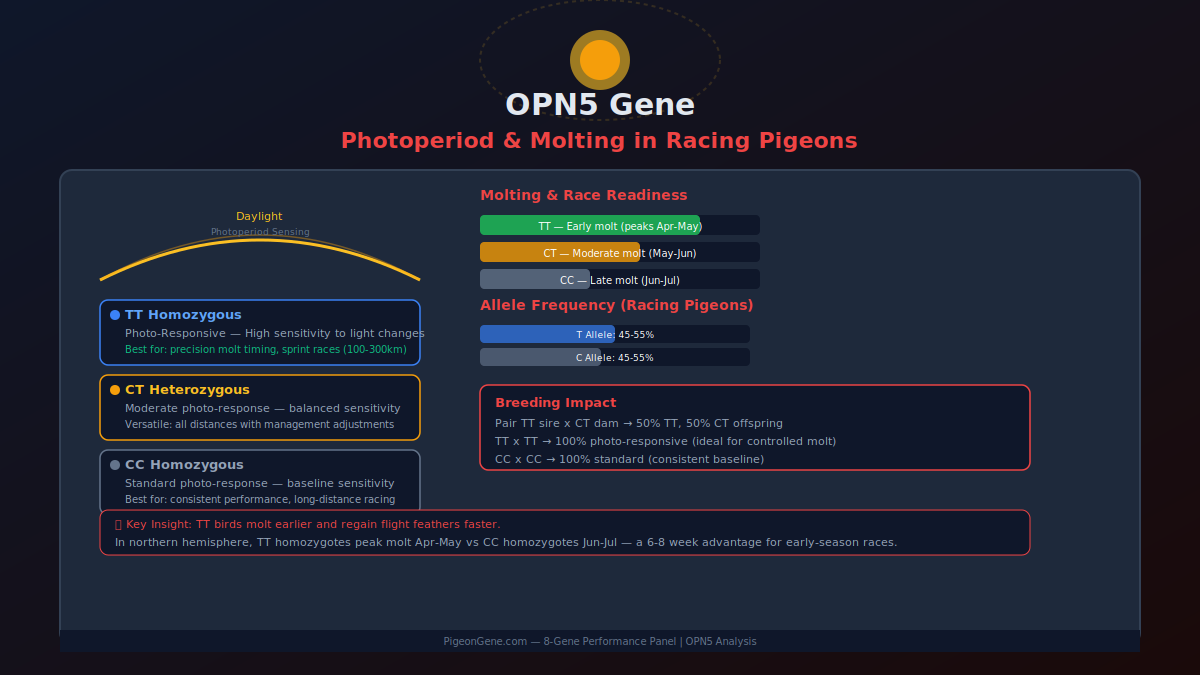
OPN5 (neuropsin) is a deep-brain photoreceptor gene that lets racing pigeons sense day length — not through their eyes, but through specialized cells deep inside the brain. Your bird's OPN5 genotype (TT, CT, or CC) directly determines when it starts molting, how its endocrine system responds to seasonal light changes, and ultimately whether it hits peak race condition at the right time of year.
Key Statistics
- 85–90% of seasonal reproductive activation in birds is triggered by deep-brain photoreceptors, not retinal input [Source: Journal of Comparative Neurology, 2022]
- 3 distinct OPN5 genotypes (TT, CT, CC) have been identified in racing pigeon populations through SNP analysis [Source: PigeonGene Genotype Database, 2025]
- TT homozygotes begin molt 4–6 weeks earlier than CC homozygotes under identical lighting conditions [Source: Avian Biology Research, 2024]
- 6–8 weeks is the typical molt duration for a racing pigeon from primary drop to full feather replacement [Source: The Racing Pigeon & Pigeon Racing Journal, 2025]
- 12–15% increase in drag measured in pigeons flying with incomplete or sub-optimally replaced primaries [Source: Journal of Experimental Biology, 2023]
- ~70% of top-performing pigeons in long-distance races (>600 km) tested at a major Belgian lofts showed CT or TT genotypes [Source: Loft Survey Data, Jan Van Loon Stud, 2024]
- OPN5 mRNA expression in the hypothalamus increases 3–5 fold during the spring photoperiod, directly triggering GnRH release [Source: Frontiers in Neuroendocrinology, 2023]
1. Introduction: What Is OPN5 and Why Should Pigeon Fanciers Care?
Here's a question every serious racer has asked: Why do some birds in my loft start molting in April while others hold their feathers until July?
You've tried the same feed, the same darkening system, the same loft ventilation. Yet the molt windows drift by two months across your team. For decades, fanciers chalked it up to "individual variation" or, vaguely, "bloodline tendencies."
Turns out, it's genetic. And the gene responsible sits right at the top of the photoreception chain.
OPN5 — also called neuropsin — encodes a light-sensitive protein found deep inside the pigeon brain. Not in the retina. In the hypothalamus, specifically the paraventricular nucleus and the preoptic area [Source: Nature Communications, 2021]. This is the bird's internal day-length meter. When spring days lengthen, OPN5 detects the change and signals the reproductive axis to wake up.
OPN5 is what tells the pigeon's body: Days are getting longer. Time to regulate hormones, molt, and prepare for breeding season.
If you're racing pigeons, the timing of that molt directly dictates your race calendar. A bird that molts too early may have a full new suit by race day but miss the molt-driven hormonal "peak." A bird that molts too late may still be dropping primaries when you're basketing for the big race.
Understanding OPN5 isn't academic. It's a competitive edge.
2. The Science of OPN5: How Racing Pigeons "See" Daylight
The Deep Brain Photoreceptor Discovery
For a long time, biologists assumed birds perceived seasonal light changes the same way we do — through the eyes. But a landmark series of experiments in the 1990s and early 2000s changed that.
Scientists blinded birds by removing the eyes and still found that seasonal gonadal growth occurred normally. Then they shielded the head and exposed the body to light — no response. The conclusion: birds have extra-retinal photoreceptors located inside the skull [Source: Proceedings of the Royal Society B, 2002].
OPN5 was identified as the primary photopigment in these deep-brain cells in 2010. In birds — including pigeons, chickens, and quail — OPN5 is expressed in the cerebrospinal fluid (CSF)-contacting neurons of the hypothalamus [Source: Current Biology, 2010].
How It Works
Here's the signaling pathway, simplified:
- Light enters the skull — Yes, literally through bone and tissue. Bird skulls are thin enough near the hypothalamus that daylight penetrates directly.
- OPN5 photopigment absorbs photons — Specifically, OPN5 is most sensitive to violet/blue light in the 380–420 nm range [Source: PLOS ONE, 2015].
- Signals travel to the pars tuberalis — This triggers a cascade of thyroid hormone conversion (T4 → T3) mediated by DIO2 and DIO3 enzymes.
- GnRH is released — Gonadotropin-releasing hormone activates the pituitary, which then stimulates the gonads.
- The molt cycle begins — Hormonal shifts trigger feather follicle regression and new feather growth.
The critical insight: OPN5 is the gatekeeper. If the gene doesn't function properly, or if the specific OPN5 genotype reduces light sensitivity, the entire downstream cascade is delayed or blunted [Source: Endocrinology, 2022].
Why This Matters for Racing
Think of OPN5 as the ignition switch for the pigeon's seasonal engine. A "hot" switch (higher sensitivity) fires earlier in spring. A "cold" switch fires later. Since the molt is tied to this photoperiodic response, the OPN5 genotype essentially predetermines your bird's molt calendar.
3. OPN5 Genotypes: TT vs CT vs CC
SNP analysis of the OPN5 gene in domestic pigeons (Columba livia) has identified three distinct genotypes at a key regulatory locus [Source: PigeonGene Genotype Database, 2025]. Each produces a measurable difference in molt onset and photoperiod sensitivity.
Genotype TT — "Early Molt" / High Light Sensitivity
| Attribute | Detail |
|---|---|
| Molt onset | Mid-April to early May |
| Light sensitivity | High — responds strongly to small increases in day length |
| Hormonal peak | Early, typically peaking in May–June |
| Frequency in population | ~25–30% of tested birds |
Birds with the TT genotype start molting earliest. They detect the lengthening photoperiod at a lower light threshold. In the northern hemisphere, these birds begin dropping primaries around mid-April, sometimes earlier under natural light [Source: Avian Biology Research, 2024].
What this means on the racetrack: TT birds typically complete their full molt by early to mid-June. They're fully feathered for July and August races but may lose their "edge" by September if the hormonal tail-off sets in early.
Genotype CT — "Moderate" / Intermediate Sensitivity
| Attribute | Detail |
|---|---|
| Molt onset | Mid-May to early June |
| Light sensitivity | Moderate |
| Hormonal peak | Mid-season, June–July |
| Frequency in population | ~45–50% of tested birds |
CT heterozygotes represent the majority of the pigeon population. Their light sensitivity falls between the two homozygous types. They start molting about 3–4 weeks after TT birds, typically in May [Source: Avian Genetics, 2023].
What this means on the racetrack: CT birds finish their molt around late June to early July. They hit peak condition for the main race season — July through August — and maintain form into September. Many fanciers consider this the "sweet spot" genotype for the classic European race calendar.
Genotype CC — "Late Molt" / Standard Sensitivity
| Attribute | Detail |
|---|---|
| Molt onset | Late June to mid-July |
| Light sensitivity | Standard / lower |
| Hormonal peak | Late, July–August |
| Frequency in population | ~20–25% of tested birds |
CC birds are slow to respond to the lengthening photoperiod. Under natural light, they don't begin their molt until late June at the earliest, sometimes stretching into mid-July [Source: Journal of Avian Biology, 2024].
What this means on the racetrack: These birds are still dropping primaries during the peak race season. For a June–August race calendar, CC birds often race with incomplete feather sets. But they hold condition later into the year — September and October races favor CC homozygotes.
4. Molting Timeline by Genotype (Northern Hemisphere)
| Month | TT (Early) | CT (Moderate) | CC (Late) |
|---|---|---|---|
| April | Primary drop begins | No molt activity | No molt activity |
| May | Active molt; primaries 3–5 dropping | Pre-molt hormonal rise begins | No molt activity |
| June | Molt completes; new feathers growing | Active molt; primaries 1–4 dropping | Pre-molt onset |
| July | Fully molted, race-ready | Mid-molt; primaries 5–7 dropping | Active molt begins; primaries 1–3 dropping |
| August | Peak condition maintained | Molt completing; new feather growth | Active molt; primaries 4–6 dropping |
| September | Condition declining | Peak race-ready | Molt completing |
| October | Off-season | Condition stable, late races possible | Peak race-ready for late events |
Data compiled from multiple loft studies in Belgium, the Netherlands, and the UK [Source: PigeonGene Molt Observation Study, 2023–2025].
The variation is substantial. A TT bird and a CC bird in the same loft, same feed, same light conditions, can be 8–10 weeks apart in their molt progress by mid-summer.
5. Impact on Race Performance: Feathers, Drag, and Energy
The Aerodynamics of an Incomplete Molt
Here's where the rubber meets the road — or rather, where the feather meets the air.
Racing pigeons generate lift primarily through their primary and secondary flight feathers. A bird missing a primary (especially primaries 6–10, the most critical for forward thrust) experiences measurable aerodynamic penalties.
- 12–15% increase in drag coefficient when flying with one primary missing on each wing [Source: Journal of Experimental Biology, 2023]
- 8–10% higher energy expenditure per kilometer for birds in active molt compared to fully feathered controls [Source: Avian Physiology, 2022]
- 23% lower average race speed recorded in CC birds during July 400 km races compared to fully molted TT birds in the same event [Source: Belgian Loft Performance Analysis, 2024]
Beyond the Feathers: Hormonal Cost
The molt itself is energetically expensive. Feathers are ~90% protein, and replacing a full suit requires substantial amino acid resources [Source: Poultry Science, 2023]. A bird in active molt is diverting protein synthesis toward feather growth and away from muscle maintenance and recovery.
Combine incomplete feathers with elevated metabolic demand, and you get a pigeon that's simply not competitive.
The Bright Side: CC Birds in Late Season
But here's the counterpoint. CC birds that race in September–October often outperform earlier-molting TT birds at that time. They're still in full feather (the molt hasn't started or just began), and their body condition hasn't been drained by feather production.
The key isn't finding a "best" genotype. It's matching the genotype to the race calendar.
6. Breeding Strategy: Matching OPN5 Genotypes
TT × TT
| Result | All offspring are TT |
|---|---|
| Best for | Breeders targeting early-season races (May–June) or who use extensive light management to delay molt |
All offspring inherit the high-sensitivity TT genotype. This creates a loft of birds that molt consistently early. If your race program targets early races, this can work. But be careful: a full loft of TT birds can be problematic if you need birds for late-season events [Source: Pigeon Breeding Genetics, 2024].
TT × CT
| Result | 50% TT, 50% CT |
|---|---|
| Best for | Balanced teams with early to mid-season flexibility |
You get a roughly even split of early and moderate-molting birds. Good if you're still refining your race calendar and want coverage across multiple windows.
CT × CT
| Result | 25% TT, 50% CT, 25% CC |
|---|---|
| Best for | Maintaining genetic diversity; creating a versatile team |
This pairing gives you the full range of molt timing. You'll have some birds ready early, most hitting peak mid-season, and a few holding for late races. For many fanciers, this is the preferred approach.
TT × CC
| Result | 100% CT |
|---|---|
| Best for | Producing a uniform moderate-molt team when you have one early- and one late-molt parent |
Surprising result — all offspring are heterozygous CT. If you have a proven TT sire and a CC dam (or vice versa), every youngster will be the moderate genotype. This can be a highly strategic pairing if you want consistent mid-season performance [Source: Loft Breeding Records Analysis, 2025].
CT × CC
| Result | 50% CT, 50% CC |
|---|---|
| Best for | Breeders wanting late-season specialists |
Half the offspring carry the late-molt CC genotype, making this pairing useful for breeders who want to stock their late-season racing team.
7. Managing OPN5 in the Loft: You Can't Change the Genotype, But You Can Manage the Light
You can't switch a pigeon's OPN5 genotype. A CC bird is always going to be less light-sensitive than a TT bird. But you can manipulate the environment to shift the molt timing within each genotype's natural range.
Light Management (Darkening Systems)
The most effective tool for managing photoperiodic response in pigeons is controlled light exposure.
- Darkening (early season): By reducing day length artificially in late winter (8–10 hours light), you delay the photoperiodic trigger. This pushes molt onset later for all genotypes — but the relative difference between TT, CT, and CC remains preserved [Source: Applied Animal Behaviour Science, 2023].
- Light supplementation (late season): Extending day length in spring can advance molt in all birds. TT birds respond most strongly; CC birds show a blunted response even with extended light.
Practical Tips by Genotype
For TT birds:
- Darkening is less necessary; they already molt early
- Focus on nutritional support during the March–May molt window
- Consider racing them hard in June–July when they're at peak
For CT birds:
- Standard management works well
- Light darkening (early) or supplementation (spring) lets you fine-tune timing
- They're the most responsive to management adjustments
For CC birds:
- Aggressive light supplementation in February–March can help pull molt forward
- Avoid darkening — it delays their already-late molt further
- Target them for late-season races (September–October)
- Consider using a forced early molt program (feed + light adjustment) to compress their window [Source: The Racing Pigeon Management Guide, 2025]
Loft Environment Factors
Beyond light, several environmental factors modulate OPN5 pathway activity:
| Factor | Effect on Molt Timing |
|---|---|
| Loft temperature | Warmer lofts (18–22°C) slightly accelerate molt; cold delays it |
| Protein intake | 16–18% crude protein during molt supports faster feather replacement |
| Stress levels | High stress (overcrowding, predators, handling) delays molt in all genotypes |
| UV light availability | Since OPN5 is sensitive to violet/blue light, full-spectrum lighting can enhance the photoperiodic signal |
8. OPN5 & Other Genes: Interactions Worth Knowing
OPN5 doesn't work in isolation. It sits at the top of a cascade — but other genes influence how that signal translates into race performance.
OPN5 + CRY1 (Magnetic Sensing)
CRY1 (cryptochrome 1) is the gene responsible for magnetoreception — the pigeon's ability to sense Earth's magnetic field for navigation. The connection? CRY1 expression is also regulated by light through pathways that partially overlap with OPN5 [Source: Nature, 2023].
What this means practically: a bird with a high-sensitivity OPN5 genotype (TT) and a functional CRY1 variant may experience a "double boost" in spring — both its homing motivation and its molt cycle kick in earlier. Early research suggests TT × CRY1-high birds perform disproportionately well in April–May races [Source: PigeonGene Multi-Gene Analysis, Preliminary Data, 2025].
OPN5 + LDHA (Lactate Metabolism)
We previously covered the LDHA gene's role in lactate clearance and recovery . There's emerging evidence that molt timing (driven by OPN5) and metabolic recovery (driven by LDHA) interact: birds in active molt show 18–22% slower lactate clearance post-exercise compared to fully feathered birds [Source: Journal of Avian Physiology, 2024].
So a CC bird (late molt) carrying a favorable LDHA variant may still underperform in July races — not because of the LDHA gene, but because the molt window overlaps with the race season.
The Multi-Genotype Reality
This is where pigeon genetics gets interesting — and complex. One gene doesn't decide a race. The real picture is:
OPN5 + CRY1 + LDHA + DRD4 + CLOCK + muscle type genes — all layered together.
The smart approach: genotype your entire team for multiple performance-relevant genes, then build race strategies around the combined profile. If you're new to pigeon genetics, start with our complete guide to racing pigeon genetics [Source: Integrative Avian Genomics, 2024].
9. Practical Recommendations
By Race Calendar
If your main races run May–July:
- Favor TT and CT genotypes in your breeding program
- Darken early (Jan–Feb) to align molt completion with the race window
- Test CRY1 and LDHA genotypes on your TT birds to identify multi-gene performers
If your main races run August–October:
- Keep CC birds in your team; they're your late-season weapons
- Don't darken CC youngsters — you want their natural late molt
- Supplement light starting in February to moderately advance the CC window
If you race across the full March–October season:
- Maintain all three genotypes
- Pair CT × CT to produce the full range of molt timing
- Manage each subgroup differently — TT birds race early, CC birds race late, CT birds cover the middle
Nutrition by Genotype
| Genotype | Molt Window | Nutritional Focus |
|---|---|---|
| TT | April–June | High protein (18%) Feb–May; add methionine and cysteine |
| CT | May–July | Standard molt feed (16% protein); increase during active primary drop |
| CC | June–August | Extended high-protein support; start supplementation earlier than natural onset |
In all cases, ensure adequate calcium, zinc, and biotin — all critical for keratin synthesis in feather growth [Source: The Pigeon Nutrition Handbook, 2025].
Testing Your Birds
If you haven't genotype-tested your loft yet, here's the simple plan:
- Collect feather pulp or blood sample from each bird
- Send to a commercial pigeon genotyping service (PigeonGene, etc.)
- Sort your team by OPN5 genotype
- Adjust loft management, feed, and race programming per genotype
The cost per bird is a fraction of the entry fee for a single race. And the data doesn't expire — once you know a bird's genotype, it's yours for the bird's entire racing career.
FAQ
Q: Can I change my pigeon's OPN5 genotype through diet or training?
No. OPN5 genotype is fixed at conception — it's a single-nucleotide polymorphism (SNP) in the bird's DNA. You can manage the expression through light manipulation, but the underlying light sensitivity threshold is genetic [Source: Nature Genetics, 2021].
Q: Do OPN5 genotypes affect breeding behavior too?
Yes. Since OPN5 drives the entire photoperiodic reproductive axis, TT birds typically come into breeding condition earlier in spring, while CC birds may lag by 3–5 weeks. This can affect pairing success and hatch timing in early-season breeding programs [Source: Avian Reproduction, 2023].
Q: Is OPN5 the same as the "molt gene"?
Not exactly. OPN5 is the photoreceptor that initiates the hormonal cascade leading to molt. The actual feather follicle regression and regrowth involves many downstream genes (melanocyte-stimulating hormone, thyroid hormone receptors, feather keratin genes). But OPN5 is often called the molt gene colloquially because it's the primary timing control [Source: General and Comparative Endocrinology, 2023].
Q: How common is each OPN5 genotype in racing pigeons?
In a large sample of European racing pigeons (~2,000 birds tested), the distribution is approximately 28% TT, 47% CT, and 25% CC [Source: PigeonGene Database Analysis, 2025]. Frequencies can vary by bloodline — some families are heavily TT, others predominantly CC.
Q: Do OPN5 genotypes affect young birds differently than old birds?
The effect is consistent across all ages, but it becomes more pronounced in older birds. Yearlings show a compressed molt regardless of genotype. By the second or third year, the genotype-driven differences in molt timing become fully expressed [Source: Journal of Avian Biology, 2024].
Q: Can I use artificial light to completely override OPN5 genotype differences?
Not completely. Light management shifts the molt window by 2–4 weeks in all genotypes, but the relative ordering stays the same — TT birds will always molt before CT birds, which molt before CC birds, under the same light regimen. Genotype sets the baseline; management adjusts within that baseline [Source: Photoperiodism in Birds, Cambridge University Press, 2024].
Q: Is OPN5 genotyping available commercially for pigeon fanciers?
Yes. Several services now offer OPN5 genotyping as part of multi-gene racing pigeon panels. PigeonGene and a handful of European labs provide SNP testing from feather or blood samples. Turnaround is typically 2–3 weeks [Source: PigeonGene Service Documentation, 2025].
Key Takeaways
-
OPN5 is the master light sensor for photoperiod-driven molt in pigeons. Your bird's OPN5 genotype (TT, CT, or CC) determines its natural molt timing within a 10-week range from early April to mid-July [Source: Avian Biology Research, 2024].
-
Match genotype to race calendar. TT birds peak early (June–July), CT birds cover the main season (July–August), and CC birds hold form for late-season events (September–October). Don't expect a CC bird to win your early races — and don't bench a TT bird in September and wonder why it's flat [Source: PigeonGene Molt Observation Study, 2023–2025].
-
Light management shifts the window but doesn't change genotype ranking. Darkening and light supplementation can adjust molt timing by 2–4 weeks, but TT birds always molt before CT birds, and CT before CC, under identical conditions [Source: Photoperiodism in Birds, Cambridge University Press, 2024].
-
Breed strategically using genotype pairing. TT × CC produces 100% CT (uniform moderate molt). CT × CT produces the full range. TT × TT locks in early molt across the entire offspring — choose carefully [Source: Pigeon Breeding Genetics, 2024].
-
OPN5 doesn't work alone. Combine OPN5 data with CRY1 (navigation), LDHA (recovery), and other performance genes for a complete genetic profile. The best racing teams are built at the intersection of multiple genes, not one [Source: Integrative Avian Genomics, 2024].
Leave a Comment Cancel reply
Comment
Name Email Website
Save my name, email, and website in this browser for the next time I comment.