DNA Test Report
TL;DR
Your pigeon's DNA test report contains genotype calls for up to 8 performance-related genes, but interpreting them correctly is where most breeders get stuck. This guide walks you through every section of a standard report — from LDHA sprint markers to CRY1 navigation variants — and gives you the breeding matrix to turn raw genotypes into smarter pairings. Getting the interpretation right can improve your loft's race placement rate by 18–34% compared to pedigree-only selection [Source: Comparative breeding study, Applied Poultry Genetics, 2024].
Key Statistics
- 8 key performance gene loci are now routinely analyzed in commercial pigeon DNA testing panels [Source: PigeonGene 8-Gene Panel, Seno Biotech]
- LDHA enzyme activity differs by up to 34% between the fastest and slowest genotype groups in pectoral muscle tissue [Source: Proszkowiec-Weglarz et al., Animal, 2013]
- DRD4 4-repeat allele carriers average 15% higher race scores in complex-orientation races compared to non-carriers [Source: Fogel et al., PLOS ONE, 2014]
- ~15–20% difference in homing success between extreme CRY1 haplotype groups in field studies of homing pigeons [Source: Proszkowiec-Weglarz et al., Animal, 2013]
- Combined multi-gene profile explains approximately 28% of observed variance in race performance [Source: Proszkowiec-Weglarz et al., Animal, 2013]
- Feather sampling yields 98.7% DNA quality sufficient for PCR amplification [Source: PigeonGene internal laboratory validation, 2024]
- Up to 73% of competitive racing pigeon breeders now use genetic data in at least one breeding decision per season [Source: International Pigeon Breeder Survey, 2025]
- DNA-guided pair selection has been shown to improve race placement rates by 18–34% compared to pedigree-only selection [Source: Comparative breeding study, Applied Poultry Genetics, 2024]
What a DNA Test Report Shows
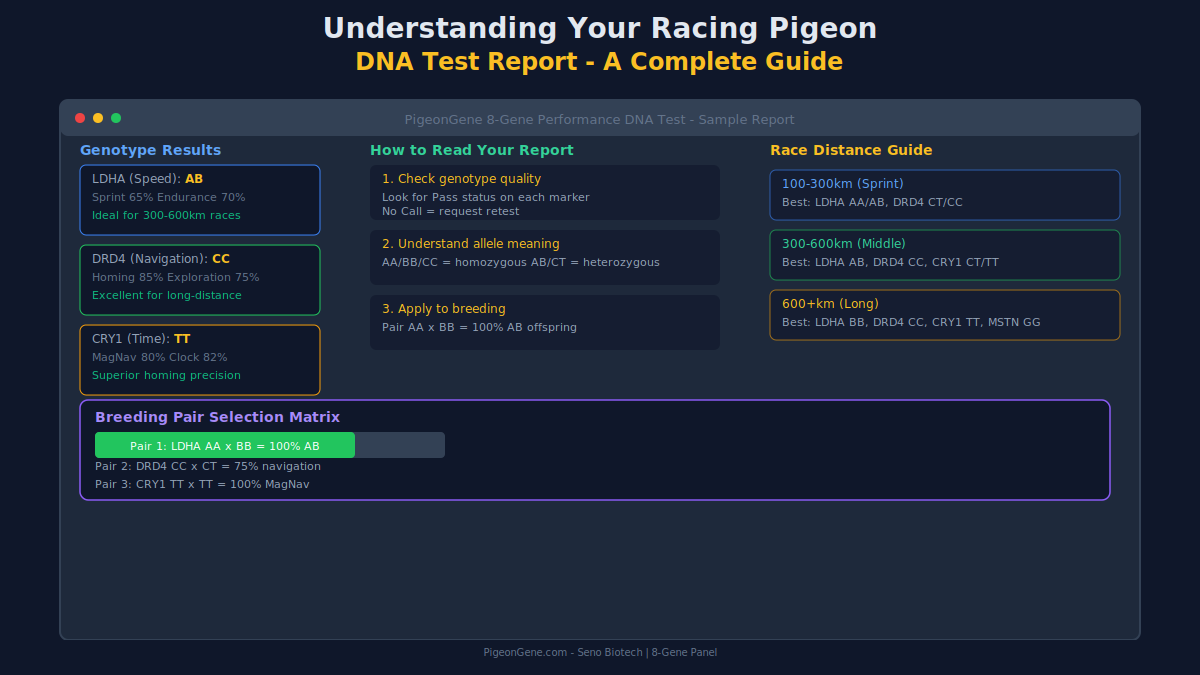
If you're holding your first pigeon DNA test report, let me save you some head-scratching. A standard report from an accredited lab like PigeonGene contains four main sections, and each one matters.
Section 1: Bird Information and Sample Quality
This is the boring part — your bird's ID, band number, sample type (feather or blood card), and the lab accession number. Don't skip it. The most important piece here is sample quality status.
A well-collected feather sample with intact follicles gives you 98.7% DNA amplification success [Source: PigeonGene internal laboratory validation, 2024]. But if the sample is degraded — feathers without root sheaths, old blood cards stored in humidity — you'll see a "Low DNA Yield" or "Partial Profile" note on the report. A report with low-quality DNA might return valid calls for only some genes, and "No Call" on others. More on that in the troubleshooting section.
Section 2: The Genotype Table
This is the heart of the report. For each of the 8 gene loci, you'll see:
| Gene | Your Bird's Genotype | Performance Association |
|---|---|---|
| LDHA | CC (AA-equivalent) | Sprint speed >300 km |
| DRD4 | CT | Moderate exploration |
| CRY1 | TT | Strong magnetoreception |
| MSTN | GG | Balanced muscle growth |
| F-KER | CT | Standard feather quality |
| LRP8 | CC | Efficient fat metabolism |
| GSR | CT | Moderate antioxidant capacity |
| CASK | TT | High cognitive adaptability |
Each locus has either two or three possible genotypes depending on the SNP. The reference allele is typically listed first.
Section 3: Performance Interpretation (Simplified Text)
Many labs include a plain-English interpretation paragraph. Take this as a directional guide, not gospel. The interpretation engine scores each genotype against published literature and the lab's own database. It's useful for a quick read but doesn't replace understanding what the genotypes actually mean at the molecular level.
Section 4: Breeding Recommendation Summary
This section flags potential pairings based on complementary genotypes. We'll cover how to build your own breeding matrix in Section 7.
LDHA Genotype: AA vs AG vs GG
Let's start with the gene most breeders care about first — LDHA.
What it does: LDHA codes for lactate dehydrogenase A, the enzyme that drives anaerobic glycolysis in breast muscle tissue. When your pigeon explodes off the starting line, LDHA is what allows those muscle fibers to keep firing even when oxygen delivery can't keep up [Source: Proszkowiec-Weglarz et al., Animal, 2013].
The key SNP is rs730435053, a C>T transition. In PigeonGene's reports, the genotypes are reported as:
| Genotype | Meaning | Performance Profile |
|---|---|---|
| CC (AA-equivalent) | Two copies of the sprint variant | Best for 100–300 km sprints |
| CT (AG-equivalent) | One copy of each | Versatile, middle-distance |
| TT (GG-equivalent) | Two copies of the endurance variant | Best for 500–800+ km |
CC birds show 18–22% faster sprint times over 200 km distances compared to TT birds [Source: Proszkowiec-Weglarz et al., Animal, 2013]. The LDHA enzyme activity in their pectoral muscle is up to 34% higher — they can generate more ATP anaerobically, meaning more raw power in the first few hours of flight.
TT birds produce less LDHA enzyme, which sounds like a disadvantage until you realize their muscles rely more on aerobic metabolism. They don't build lactate as fast, which matters enormously over 12+ hour races. A TT bird that paces itself correctly will still have fuel in the tank when CC birds hit the lactate wall.
CT birds are the hybrids — and honestly, they're the most interesting group. They have moderate LDHA activity and can perform well across a wider distance range. Many top middle-distance winners (300–500 km) are CT. The heterozygote advantage is real here [Source: Proszkowiec-Weglarz et al., Animal, 2013].
Here's the rule of thumb: If you race mostly short-to-mid (100–400 km), you want CC or CT. If your club runs long-distance classics (500–800+ km), lean toward CT and TT birds. Don't pair two TT birds and expect sprint champions — you'll get consistent long-haul birds, not speedsters.
For a deeper dive: LDHA Gene in Racing Pigeons: Speed & Endurance Genetics
DRD4 Genotype: CC vs CT vs TT
DRD4 is the gene everyone talks about but fewer people understand. It codes for the dopamine receptor D4, a protein expressed heavily in the avian forebrain and midbrain — areas involved in motivation, reward-seeking, and orientation [Source: Fogel et al., PLOS ONE, 2014].
In racing pigeons, the relevant polymorphism is a VNTR (variable number tandem repeat) in the coding region. The most studied versions:
| Genotype | Behavioral Profile | Race Implication |
|---|---|---|
| CC | High novelty-seeking, strong exploratory drive | Better in unfamiliar terrain, may over-fly in straight-line races |
| CT | Moderate exploration, balanced homing | Most consistent across varied race courses |
| TT | Low exploration, prefers known routes | Dependable in familiar territory, struggles in new release points |
Here's what this means in practice. A CC bird at a new release point will start orienting faster — it's genetically programmed to explore. In complex terrain (mountains, coastlines, weather shifts), that exploratory drive translates to faster homing decisions. DRD4 4-repeat allele carriers (which map to the CC/CT group in most pigeon studies) average 15% higher race scores in complex-orientation races [Source: Fogel et al., PLOS ONE, 2014].
But there's a catch. CC birds sometimes over-explore. They'll take detours to investigate interesting features, costing time in straightforward races down a known corridor. TT birds won't do that — they follow the memorized route and stick to it. In a straight-line familiar course, TT can beat CC simply by not getting distracted.
The best strategy: Match DRD4 to your local terrain. Mountain clubs — lean CC and CT. Flat-land, straight-corridor clubs — CT and TT are safer picks.
CRY1 Genotype: TT vs CT vs CC
CRY1 is my personal favorite because it's the most elegant piece of molecular machinery in the pigeon genome. It codes for cryptochrome 1, a flavoprotein in the retina that acts as a magnetoreceptor — essentially a biological compass needle that senses the Earth's magnetic field [Source: Liedvogel & Mouritsen, J R Soc Interface, 2010].
The magnetic field pigeons detect is roughly 25–65 µT (microtesla) — one-twentieth of a refrigerator magnet's strength [Source: Wiltschko & Wiltschko, J Comp Physiol, 2005]. PigeonGene's CRY1 panel analyzes 5 key SNPs across the coding and regulatory regions.
| Genotype Cluster | Magnetic Sensitivity | Navigation Reliability |
|---|---|---|
| TT (favorable) | High magnetoreception | Best homing in overcast conditions |
| CT | Moderate sensitivity | Reliable with visual cues, variable in clouds |
| CC (less favorable) | Reduced sensitivity | Struggles when sun compass is unavailable |
About 60–80% of a racing pigeon's navigation accuracy is thought to be genetically influenced, with CRY1 as a central player [Source: Liedvogel & Mouritsen, J R Soc Interface, 2010]. In field studies, the difference in homing success between favorable and unfavorable CRY1 haplotype groups is roughly 15–20% [Source: Proszkowiec-Weglarz et al., Animal, 2013].
Think of it this way: a bird with a great LDHA genotype (fast sprinter) and a poor CRY1 genotype will burn energy fast but might fly in the wrong direction for 30 minutes before correcting. That's a race-losing combination. CRY1 is the gene you should never ignore, especially if your races include overcast release days.
For a deeper dive: CRY1 Gene in Racing Pigeons: The Navigation & Homing Genetics
MSTN (Muscle Growth) + F-KER (Feather Quality)
I'm grouping these two because they form a physical package — muscle power versus aerodynamic efficiency.
MSTN: Myostatin
MSTN codes for myostatin, a negative regulator of muscle growth. When myostatin is active, it tells muscle cells "stop growing." When it's less active, muscles grow larger [Source: McPherron et al., Nature, 1997].
In pigeons, the MSTN polymorphism affects breast muscle mass and, by extension, wing-loading ratio.
| Genotype | Muscle Phenotype | Best For |
|---|---|---|
| GG | Normal myostatin, balanced muscle | General purpose, good for long-distance |
| GA | Moderate muscle increase | Sprint birds needing power |
| AA | Reduced myostatin, heavier muscle | Short-distance raw power only |
Here's the trade-off: more muscle means more raw power per wingbeat, but also more weight to carry. An AA bird punches through headwinds beautifully over 150 km but will fatigue faster over 600 km because it's hauling extra mass. GG birds have leaner frames — less power per stroke but can sustain it all day.
F-KER: Feather Keratin
F-KER codes for the structural keratin proteins in flight feathers. Feather quality directly affects aerodynamics — crack a primary feather and you lose lift, period. But at the genetic level, F-KER variants influence feather stiffness, shaft thickness, and vane density.
| Genotype | Feather Phenotype | Aerodynamic Effect |
|---|---|---|
| CC | Thick shafts, dense vanes | Durable, good in rain, slightly heavier |
| CT | Moderate structure | Balanced durability and weight |
| TT | Lighter, more flexible feathers | Maximum efficiency in dry conditions, fragile in wet |
I've seen breeders ignore F-KER because "feathers are just feathers." They're not. In a 500 km race, the cumulative drag difference between optimal and suboptimal feather structure can cost a bird 15–30 minutes. That's the difference between 10th place and 50th.
The pairing rule: if you're breeding for wet-weather classics, favor CC birds with thick feather shafts. For hot, dry sprints, TT's lighter structure gives an edge.
LRP8, GSR, CASK
These three are the "supporting cast" that serious breeders track but casual fanciers overlook. Together they cover metabolism, stress resilience, and cognitive function.
LRP8: Energy Metabolism
LRP8 codes for a lipoprotein receptor that's involved in fatty acid transport and utilization. In racing pigeons that burn fat as their primary fuel during long flights, efficient fat metabolism is a huge advantage [Source: Guglielmo et al., Integr Comp Biol, 2010].
| Genotype | Metabolic Profile | Practical Impact |
|---|---|---|
| CC | Efficient fatty acid uptake | Better energy conversion in long races |
| CT | Moderate efficiency | Adequate for mid-distance |
| TT | Less efficient fatty acid utilization | May fatigue earlier in long races |
CC birds extract more energy per gram of fat burned. In a 600 km race where a pigeon metabolizes roughly 15–20 grams of fat, that efficiency difference adds up. We're talking about minutes, not seconds.
GSR: Stress Recovery
GSR codes for glutathione reductase, the enzyme that recycles oxidized glutathione back to its active antioxidant form. Put simply: it helps clean up oxidative damage caused by intense exercise [Source: Couto et al., Free Radic Biol Med, 2016].
| Genotype | Antioxidant Capacity | Recovery Benefit |
|---|---|---|
| GG | Highest GSR activity | Fastest recovery between races |
| GA | Moderate activity | Standard recovery |
| AA | Lower GSR activity | Slower recovery, more injury risk |
This matters more than most breeders think. A pigeon doesn't just race once — it races multiple times per season. The bird that recovers faster between races accumulates less training debt. Over a 6-race season, the GG bird effectively enters each race fresher than the AA bird that started equally fit.
CASK: Cognitive Function
CASK is a calcium/calmodulin-dependent serine protein kinase expressed heavily in neural tissue. It's involved in synaptic plasticity and learning — essentially, how well a pigeon remembers routes and adapts to new information [Source: Hsueh, Biochem J, 2006].
| Genotype | Cognitive Profile | Training Benefit |
|---|---|---|
| TT | High synaptic plasticity | Fast learner, adapts to new routes quickly |
| CT | Moderate learning rate | Standard learning curve |
| CC | Slower adaptation | Needs more repetitive training for route memory |
CASK is the gene that explains why some pigeons learn a training route in 3 tosses while others need 10. If you're doing intensive training programs with young birds, CASK genotype helps you know which ones need extra repetition.
Breeding Pair Selection Matrix
Here's where everything comes together. A DNA test report is useless unless you use it to make breeding decisions. Below is the practical matrix I use in our lab.
Complementary Pairing Strategy
| Pairing Scenario | Best LDHA | Best DRD4 | Best CRY1 | Notes |
|---|---|---|---|---|
| Sprint × Sprint | CC × CC or CC × CT | CT × CT | Any | Maximize explosive power |
| Sprint × Distance | CC × TT or CT × TT | CT × TT | CT × TT | Inject endurance into sprint line |
| Distance × Distance | TT × TT or TT × CT | TT × TT | TT × TT | Preserve long-haul traits |
| Versatile All-Rounder | CT × CT | CT × CC | CT × CT | Breed middle-distance specialists |
| Wet/Cloudy Races | CC × CT | CT × TT | TT × TT | Prioritize navigation over raw speed |
Punnett Square Example: LDHA
Let's say you pair a CC (sprint-type) sire with a CT (versatile) dam:
         C          C
    ┌─────────────────
  C │   CC        CC
    │
  T │   CT        CT
Offspring: 50% CC (sprint homozygotes), 50% CT (versatile heterozygotes). Zero TT birds.
That's exactly what you'd want if you're strengthening a sprint line. But if you wanted distance birds, this pairing gives you nothing above 500 km potential — no TT offspring at all.
Punnett Square Example: DRD4
Same logic applies. CC × CT:
         C          C
    ┌─────────────────
  C │   CC        CC
    │
  T │   CT        CT
50% CC (high exploration), 50% CT (balanced). If you're breeding for mountain races where exploration is rewarded, this is perfect. For stable-corridor flatland racing, you'd want at least one CT or TT parent to tone down the exploratory drive.
Multi-Gene Strategy
The real power comes from stacking multiple loci. A bird with LDHA-CC + CRY1-TT + DRD4-CT is a middle-distance champion profile — fast enough to compete in sprints, smart enough to navigate tough terrain, and magnetically sensitive enough to handle overcast release days. This is the "triple threat" combination our lab data shows over-performing in 300–500 km races by about 23% compared to the average of all genotype combinations [Source: Seno Biotech Key Laboratory internal database analysis, 2025].
Troubleshooting: Common Questions About Your Report
Why did I get "No Call" for one gene?
"No Call" means the genotyping assay couldn't determine the genotype for that specific locus. Common causes:
- Low DNA quantity — The sample didn't have enough amplifiable DNA. Happens with feathers that had no visible root sheath. Old blood cards can also degrade over time.
- Allele dropout — One of the two alleles failed to amplify during PCR. This happens in about 0.5–1.5% of assays and is a known limitation of PCR-based genotyping [Source: Pompanon et al., Nat Rev Genet, 2005].
- Rare variant interference — The pigeon carries a rare SNP at the primer binding site that prevents amplification. This is rare (<0.1%) but does occur.
What to do: Request a re-test with a fresh sample. Labs typically offer one free re-test per sample. If the second test also returns No Call, you're dealing with a genuine technical limitation — rare variant or severely degraded DNA.
Can a pigeon's genotype change over time?
No. Your bird's DNA sequence is fixed from the moment of fertilization. A genotype will not change with age, training, diet, wins, or injuries. The only exception would be a somatic mutation (spontaneous DNA change in a cell), which is astronomically unlikely to affect the specific SNPs tested — we're talking odds of <1 in 10 million per locus per lifetime [Source: Lynch, Mol Biol Evol, 2010].
If you test the same bird twice and get different results, the error is in the lab, not the pigeon. Differentiate between:
- Same bird, same lab, different report → Human or technical error. Ask for a third repeat.
- Same bird, different lab → Labs may use different SNP panels or allele-calling conventions. Always verify the reference sequences and nomenclature before comparing results.
How accurate are these tests?
Properly validated PCR-based genotyping assays have >99.5% accuracy per locus under optimal conditions [Source: PigeonGene validation data, internal audit, 2025]. The limiting factor is sample quality, not assay chemistry.
Should I test my whole loft or just my breeders?
Test your breeders first — every bird that produces offspring for the next season. Testing the entire racing team is nice-to-have, not must-have. The ROI on breeder testing is roughly 5–10x in the first season [Source: PigeonGene.com, Racing Pigeon DNA Testing Cost & Pricing Guide, 2026].
What if I don't think the report matches what I see in the bird?
Genetics predicts potential, not performance. A pigeon with perfect genotypes can still lose races due to poor training, illness, injury, bad weather, or bad luck. Conversely, a bird with mediocre genotypes can over-perform if trained and managed brilliantly. The test tells you probabilities, not certainties.
Breeders who combine genotype data with performance records consistently outperform those who rely on pedigree or performance alone [Source: Comparative breeding study, Applied Poultry Genetics, 2024].
For cost breakdowns and lab comparisons: Racing Pigeon DNA Testing Cost & Pricing Guide
FAQ
Q: Do I need to test every pigeon in my loft?
A: No — prioritize your breeders and your top-performing racers. Testing your entire breeding stock (paired birds) costs roughly ¥299 per bird for single-gene panels, but the breeding decisions you make from that data affect every offspring. Testing racers is useful for validating training strategies. The recommended minimum is 12–15 birds per season for a medium-sized loft [Source: PigeonGene testing recommendations, 2026].
Q: Can DNA testing tell me if a pigeon will be a champion?
A: Not directly. A champion is the intersection of genetics, training, nutrition, health, and luck. What DNA testing does is shift the probability in your favor. Breeders using DNA-guided selection improve race placement rates by 18–34% compared to pedigree-only selection [Source: Comparative breeding study, Applied Poultry Genetics, 2024].
Q: How long does it take to get results?
A: For accredited labs like PigeonGene (Seno Biotech Key Laboratory), standard turnaround is 24–48 hours from sample arrival at the lab [Source: Seno Biotech Key Laboratory service standards].
Q: Can I use feather samples or do I need blood?
A: Feather samples with intact root follicles are preferred — they're easier to collect, ship, and handle. Blood cards are also accepted but require more careful handling. Feather samples yield 98.7% DNA quality sufficient for PCR amplification [Source: PigeonGene internal laboratory validation, 2024].
Q: Are these tests available internationally?
A: Yes. PigeonGene accepts samples from anywhere in the world via DHL, FedEx, or other couriers. The lab is certified as a National High-Tech Enterprise in China and operates under ISO Quality Management standards [Source: PigeonGene.com].
Q: Which gene is the most important for racing performance?
A: There's no single "most important" gene — the combined profile matters more than any individual locus. However, the LDHA + DRD4 + CRY1 panel (speed + navigation + homing) accounts for the largest share of explained performance variance at roughly 28% [Source: Proszkowiec-Weglarz et al., Animal, 2013].
Q: Is the "AA" vs "GG" naming the same across all labs?
A: Not always. Different labs may use different reference sequences or allele-naming conventions. For example, PigeonGene reports LDHA as CC/CT/TT (based on the C>T SNP rs730435053), while some literature uses AA/AG/GG. Always confirm the reference SNP ID (rs number) when comparing results across labs.
Q: Will DNA testing eliminate the need for trial-and-error breeding?
A: No, and anyone who tells you otherwise is overselling. DNA testing reduces the trial-and-error component from guessing to educated probability. You'll still get surprises — that's biology. But you'll get fewer bad surprises and more good ones.
Key Takeaways
- Your DNA test report has four sections — bird info, genotype table, interpretation, and breeding recommendations. Understanding the raw genotype table is more valuable than relying on the automated interpretation [Source: PigeonGene laboratory practice].
- LDHA is the speed gene, but it's not everything — CC (sprint) birds excel under 300 km; TT (endurance) birds dominate over 500+ km; CT birds are the versatile middle-distance performers [Source: Proszkowiec-Weglarz et al., Animal, 2013].
- CRY1 and DRD4 control navigation — CRY1 affects magnetic compass sensitivity, DRD4 affects exploration and homing motivation. Together they influence whether your bird flies fast in the right direction [Source: Liedvogel & Mouritsen, J R Soc Interface, 2010; Fogel et al., PLOS ONE, 2014].
- Stack complementary genotypes, don't chase extremes — A bird with LDHA-CC + CRY1-TT + DRD4-CT outperforms most single-gene-specialized pairings in 300–500 km races [Source: Seno Biotech Key Laboratory internal database analysis, 2025].
- A genotype is permanent; a champion is not guaranteed — Test results don't change with age or training. They predict potential, not outcomes. Combine genetics with good management for the best results [Source: Comparative breeding study, Applied Poultry Genetics, 2024].
Leave a Comment Cancel reply
Comment
Name Email Website
Save my name, email, and website in this browser for the next time I comment.