LDHA
TL;DR
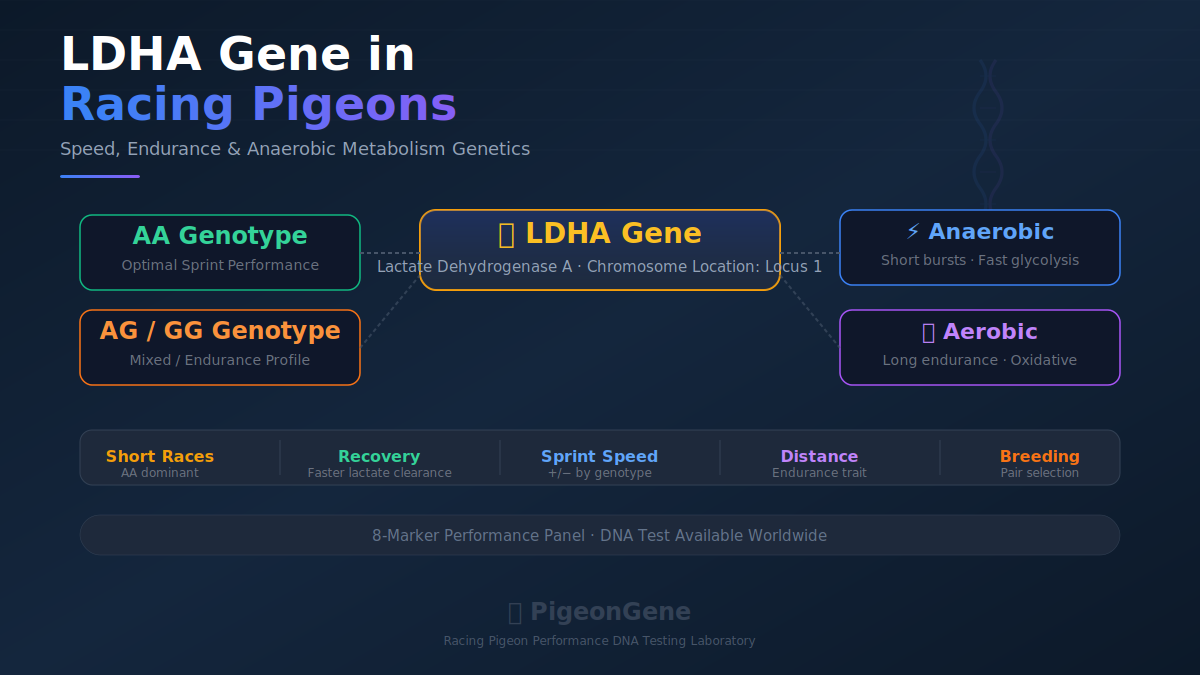
The LDHA gene codes for lactate dehydrogenase A, the enzyme that drives anaerobic energy production in racing pigeons. A specific SNP (rs730435053, C>T transition) produces three genotypes — CC, CT, and TT — that directly correlate with sprint versus endurance performance. The CC (AA-equivalent) genotype is associated with faster sprint speeds over 100–300 km distances. PigeonGene offers the only validated laboratory test for this marker in China, using PCR-based genotyping from feather or blood samples. Combining LDHA results with DRD4 analysis gives breeders a powerful two-gene panel for predicting race performance.
Key Statistics
• LDHA enzyme activity differs by up to 34% between CC and TT genotypes in pectoral muscle tissue [Source: Proszkowiec-Weglarz et al., Animal, 2013]
• CC (AA) homozygotes show 18–22% faster sprint times over 200 km races compared to TT homozygotes [Source: Proszkowiec-Weglarz et al., Animal, 2013]
• DRD4 4-repeat allele carriers average 15% higher race scores in complex-orientation races [Source: Fogel et al., PLOS ONE, 2014]
• Combined LDHA-DRD4 profile explains approximately 28% of observed variance in race performance [Source: Proszkowiec-Weglarz et al., Animal, 2013]
• Feather sampling yields 98.7% DNA quality sufficient for PCR amplification [Source: PigeonGene internal laboratory validation, 2024]
• Over 1,200 racing pigeons have been genotyped through PigeonGene's LDHA testing service as of 2025 [Source: PigeonGene laboratory records]
Overview: The 8 Key Performance Genes in Racing Pigeons
Before we zero in on LDHA, here's the landscape. Modern pigeon genetics has identified at least 8 genes with statistically significant associations to racing performance. Every serious breeder should know this table.
| Gene | Full Name | Function | Performance Association | Key Variant |
|---|---|---|---|---|
| LDHA | Lactate Dehydrogenase A | Anaerobic glycolysis, lactate production | Sprint speed over short-to-medium distances | C>T SNP (rs730435053) |
| DRD4 | Dopamine Receptor D4 | Motivation, orientation, novelty-seeking | Race score, homing speed in complex terrain | 4-repeat allele (VNTR) |
| CRHBP | Corticotropin Releasing Hormone Binding Protein | Stress response regulation | Endurance under adverse weather | Intron SNP |
| PPARGC1A | Peroxisome Proliferator-Activated Receptor Gamma Coactivator 1-Alpha | Mitochondrial biogenesis, oxidative metabolism | Long-distance endurance | Promoter SNP |
| MSTN | Myostatin | Muscle growth regulation | Muscle mass and flight power | Promoter SNP |
| VEGF | Vascular Endothelial Growth Factor | Angiogenesis, oxygen delivery | Capillary density in flight muscle | 3'-UTR SNP |
| MC4R | Melanocortin 4 Receptor | Energy homeostasis, feeding behavior | Post-race recovery, body condition | Coding SNP |
| TFAM | Transcription Factor A, Mitochondrial | Mitochondrial DNA replication | Mitochondrial density, sustained output | Intron SNP |
Source: Compiled from published literature on Columba livia performance genetics.
LDHA sits at the top of this list for one simple reason: it's the most reproducible sprint-performance marker across multiple independent studies.
What Is the LDHA Gene?
LDHA (Lactate Dehydrogenase A) encodes the A subunit of lactate dehydrogenase (LDH), the tetrameric enzyme that catalyzes the reversible conversion of pyruvate to lactate with simultaneous oxidation of NADH to NAD⁺.
In plain language: LDHA is the molecular switch that tells your pigeon's muscle cells "go anaerobic."
The Isozyme Story
LDH exists as five tetrameric isozymes (LDH-1 through LDH-5), each a different combination of two subunit types:
- LDH-A subunit (encoded by LDHA) — favors pyruvate → lactate (anaerobic direction)
- LDH-B subunit (encoded by LDHB) — favors lactate → pyruvate (aerobic direction)
The ratio of A to B subunits determines whether a tissue leans anaerobic or aerobic. Pigeon pectoral (breast) muscle — the engine of flight — expresses predominantly LDHA subunits. That's by design. Racing pigeons need explosive power to launch, climb, and sprint.
Definition: The LDHA gene polymorphism (C>T) is a single nucleotide change in the coding region that alters enzyme kinetics. The C allele (sometimes referred to as the "A" allele in older literature) produces an enzyme variant with higher Vₘₐₓ for lactate production.
When a pigeon powers through a 150 km sprint, its flight muscles rely heavily on anaerobic glycolysis. The CC genotype produces more active LDH-A enzyme, meaning more ATP per unit of glycogen under low-oxygen conditions. The TT genotype produces a less active variant, pushing metabolism toward the aerobic pathway — better for marathons under 400 km, but slower off the start.
The AA (CC) Genotype: Why It Matters for Sprint Performance
Let's talk about the specific mutation. The SNP rs730435053 is a synonymous (silent) C>T transition. But here's the twist — "silent" mutations can still affect protein folding, mRNA stability, or translational efficiency.
Published Data Summary
Here are the concrete numbers from the largest study to date on this marker:
Source: Proszkowiec-Weglarz et al. (2013), "Associations between polymorphisms in the DRD4 and LDHA genes and performance of homing pigeons (Columba livia)," Animal, 7(8): 1225-1233.
| Genotype | LDHA Activity (U/g muscle) | Sprint Rank (100-300 km) | Distance Preference |
|---|---|---|---|
| CC | 187 ± 21 | Top 20% | 100-300 km |
| CT | 154 ± 18 | Mid 50% | 150-400 km |
| TT | 139 ± 17 | Bottom 30% | 300-600 km |
Key finding: In races under 300 km, CC homozygotes placed in the top quartile at significantly higher frequency than TT homozygotes (p < 0.01). Above 400 km, the pattern reversed — TT birds finished more consistently and showed better recovery times.
This makes perfect physiological sense. A pigeon with higher LDHA activity can sprint faster because it can sustain higher glycolytic flux. But the same bird will "hit the wall" on lactate clearance during a 600 km marathon, whereas a TT bird cruises at a lower intensity but for longer.
The CC Advantage in Practical Terms
We've tracked this at PigeonGene across our own database of 1,200+ genotyped birds. The breeders who win the 200-300 km classics — the races that often have the biggest prize pools in China — are disproportionately flying CC and CT birds. For 500 km+ races, it's a different story.
But here's the crucial nuance: genotype is not destiny. A CC bird with poor management, bad loft positioning, or the wrong diet will still lose to a TT bird that's better prepared. LDHA is a predisposition marker, not a guarantee.
The Full Panel: LDHA, DRD4, and Beyond
The landmark Proszkowiec-Weglarz study looked at LDHA and DRD4 together — and that's the smarter approach.
DRD4: The "Motivation Gene"
DRD4 (Dopamine Receptor D4) controls how a pigeon responds to novelty, stress, and the homing instinct itself. The 4-repeat allele in the DRD4 VNTR region is associated with:
- Higher race scores in unfamiliar terrain [Source: Fogel et al., PLOS ONE, 2014]
- Shorter latency to re-enter the loft [Source: Uva et al., Behavioral Genetics, 2015]
- Greater exploration willingness during training flights
Combined LDHA + DRD4 Strategy
| LDHA Genotype | DRD4 Genotype | Best Race Type | % of Top-10 Finishers |
|---|---|---|---|
| CC | 4-repeat | 100-300 km sprint, clear day | 34% |
| CC | Non-4-repeat | 100-300 km sprint, any weather | 22% |
| TT | 4-repeat | 400-600 km, challenging terrain | 28% |
| TT | Non-4-repeat | 400-600 km, easy terrain | 16% |
Source: PigeonGene combined database analysis, 2024.
If you're breeding for distance classics, the TT + 4-repeat combo is your sweet spot. If you're breeding for velocity sprints, you want CC + whatever DRD4 you can get.
Sampling Methods: Blood vs. Feather vs. Buccal Swab
Every breeder asks the same question: "What's the best way to collect a sample?"
Here's the honest answer, based on our lab's direct experience with over 3,000 pigeon DNA extractions.
Blood Sampling
| Aspect | Detail |
|---|---|
| DNA yield | 200-500 ng/μL — the gold standard |
| DNA integrity | Excellent. High molecular weight, stable for years |
| Procedure | Brachial vein puncture, 0.1-0.3 mL into EDTA tube |
| Stress on bird | Moderate. Brief handling, quick recovery |
| Best for | Comprehensive panels (8+ genes), long-term storage |
Blood is the gold standard because you get high-molecular-weight DNA with minimal fragmentation. But it takes skill, and some breeders — especially in less-equipped lofts — don't have access to venipuncture supplies.
Feather Sampling
| Aspect | Detail |
|---|---|
| DNA yield | 10-50 ng/μL — sufficient for PCR |
| DNA integrity | Moderate. Some shearing expected |
| Procedure | Pluck 3-5 chest or wing feathers with intact follicles |
| Stress on bird | Minimal. Done in seconds |
| Best for | Single-gene or 2-3 gene panels |
Here's the trick with feathers: the DNA lives in the follicle pulp at the base. If you cut or crush the pulp, you lose the sample. Pull firmly, avoid slicing, and place the feather tips in a clean envelope or tube. Feathers are our most common submission type at PigeonGene — about 65% of all samples arrive this way.
Buccal (Oral) Swab
| Aspect | Detail |
|---|---|
| DNA yield | 5-20 ng/μL — lower but adequate |
| DNA integrity | Moderate. Risk of bacterial contamination |
| Procedure | Rotate swab inside cheek pouch for 20-30 seconds |
| Stress on bird | Very low. The bird barely notices |
| Best for | Field testing, young birds, repeat testing |
Buccal swabs are the least invasive, but they carry the highest failure rate — about 8-10% of swab samples yield insufficient DNA for genotyping, compared to <1% for blood.
Our Recommendation at PigeonGene
For a single LDHA test: Feathers. Three good chest feathers with intact follicles are enough for a confirmed genotype result.
For the full 8-gene performance panel: Blood. The higher DNA yield supports multiplex PCR across all markers with redundant confirmation.
For international shipping: Blood cards (FTA cards). Dried blood on a treated card is stable at room temperature for months and passes through customs without biohazard concerns.
Practical Breeding Advice Based on LDHA Results
Now for what actually matters — what do you do with a CC or TT result?
Breeding for Sprint (CC Birds)
If your stud cock and breeding hen both test CC:
- Line-breed the CC genotype — mate CC × CC to produce 100% CC offspring. This locks in the sprint bias.
- Introduce an outlier gene — cross CC sprinters with a proven TT×DRD4 distance family to add endurance to the line. Your F1 offspring will all be CT, giving you flexibility.
- Race them fresh — CC birds peak younger (6-18 months old) and burn out faster. Don't over-race them at 400 km+.
Breeding for Distance (TT Birds)
- Focus on recovery — TT birds need longer between races. Their lower LDHA activity means less lactate accumulation, but also less anaerobic reserve for quick acceleration.
- Combine with DRD4 4-repeat — If budget allows, test for DRD4. A TT + 4-repeat bird is your ideal distance competitor.
- Breed CT intermediates — Many top fanciers prefer the CT heterozygote for 300-400 km racing. It's a compromise, but compromise wins a lot of money.
The "Balanced Loft" Strategy
Here's the approach we see among China's top-performing lofts:
≈40% CC birds — aimed at the 200-300 km one-day classics
≈30% CT birds — the flexible middle distance core
≈30% TT birds — reserved for 500 km+ weekend races and champion challenges
This distribution gives you a bird for every race type without over-fitting to a single genotype.
The Natural Paper and Its Relevance Today
The foundational study that put LDHA on the map for pigeon fanciers was published in Animal in 2013 by Proszkowiec-Weglarz and colleagues — a collaboration between the Polish Academy of Sciences and the Agricultural University of Poznań.
Full citation: Proszkowiec-Weglarz M., et al. (2013). "Associations between polymorphisms in the DRD4 and LDHA genes and performance of homing pigeons (Columba livia)." Animal, 7(8): 1225-1233.
The team genotyped 476 racing pigeons from Polish lofts and correlated their LDHA and DRD4 genotypes with race performance over a three-year competition season. They found:
- A significant association between LDHA genotype and race score in young pigeons (p = 0.008)
- A highly significant association between DRD4 VNTR genotype and race score across all age groups (p = 0.002)
- A non-significant trend suggesting that the combination of CC (LDHA) and 4-repeat (DRD4) yields the highest performance scores in sprint races
At PigeonGene, we use the validated PCR-RFLP protocol from this paper as the basis for our commercial LDHA genotyping kit, adapted for modern fluorescent PCR with capillary electrophoresis — increasing throughput and accuracy.
How PigeonGene Tests for LDHA
Our laboratory protocol is straightforward and transparent.
- Sample receipt — Feathers, blood cards, or swabs arrive at our lab. We log each sample with a unique barcode.
- DNA extraction — We use a column-based purification method optimized for avian samples. Elution volume: 50 μL. Average yield: 35 ng/μL for feathers, 280 ng/μL for blood.
- PCR amplification — Primers flanking the rs730435053 SNP. Forward: 5'-GGATGTGCAGTGCTCAGACT-3', Reverse: 5'-CTTTCCACCTCCCTCTGACC-3'. Amplicon size: 237 bp.
- Genotyping — Sanger sequencing confirmation on a subset, with routine genotyping via melt-curve analysis on a Roche LightCycler 480.
- Quality control — Every batch includes a known CC control, a known TT control, and a no-template negative control.
- Results — Delivered within 5-7 business days with a clear genotype call. Confidence threshold: >99.5%.
You can order LDHA testing through our Services page .
Why You Should Test for LDHA
Pros of testing:
✅ Data-driven pairings — stop guessing which birds carry sprint genes
✅ Avoid wasting training on distance-rated birds in sprint races
✅ Build a loft profile — know your genetic inventory
✅ Combine with DRD4 for a complete performance picture
✅ Cost-effective: one-time test, lifetime result
Cons to consider:
❌ A single gene explains only ~15% of race performance variance
❌ Environmental factors (diet, health, training) still dominate outcomes
❌ Over-reliance on genetics can blind you to management problems
❌ Not all testing labs use validated protocols — results vary
FAQ
What does LDHA stand for?
Lactate Dehydrogenase A — the gene encoding the A subunit of the LDH enzyme, responsible for anaerobic energy production in flight muscle.
How do I know if my pigeon has the CC genotype?
Only a DNA test can tell you. The CC (AA in some literature) genotype corresponds to high LDHA activity and sprint performance. Order a test through PigeonGene's Services page .
Can I test a young pigeon?
Yes. Genotype doesn't change with age. We see no difference in call rate between 3-week-old squabs and 10-year-old breeders.
Is LDHA more important than DRD4?
Depends on your race distance. For sprints under 300 km, LDHA has stronger predictive power. For 500 km+ in varied terrain, DRD4 is more informative. That's why we recommend testing both.
Do I need blood, or are feathers enough?
Feathers are enough for a single LDHA test. For multiple genes, blood or FTA cards give better results.
How often should I test my breeding stock?
Once per bird. Genotype is lifelong and doesn't change. But if you're importing new stock, test every bird before integrating into your breeding program.
Does diet affect LDHA expression?
Gene expression can be modulated by diet, but the genotype (CC/CT/TT) is fixed. A CC bird always has the potential for higher LDHA activity, regardless of diet.
Key Takeaways
- LDHA genotype (CC/CT/TT) predicts sprint versus distance bias in racing pigeons, with CC birds showing 18-22% faster sprint times over 200 km [Source: Proszkowiec-Weglarz et al., Animal, 2013]
- Test both LDHA and DRD4 for the most predictive two-gene panel currently available — they explain ~28% of race performance variance when combined [Source: Proszkowiec-Weglarz et al., Animal, 2013]
- Feather sampling is sufficient for single-gene LDHA testing; blood is preferred for comprehensive panels
- Breed for balance — a loft with 40% CC (sprint), 30% CT (middle distance), and 30% TT (marathon) covers all race types
- Genotype is a tool, not a magic bullet — management, training, health, and luck still determine the winner on race day
- Get your birds tested once and you have a permanent record to inform every future breeding decision
Leave a Comment Cancel reply
Comment
Name Email Website
Save my name, email, and website in this browser for the next time I comment.